

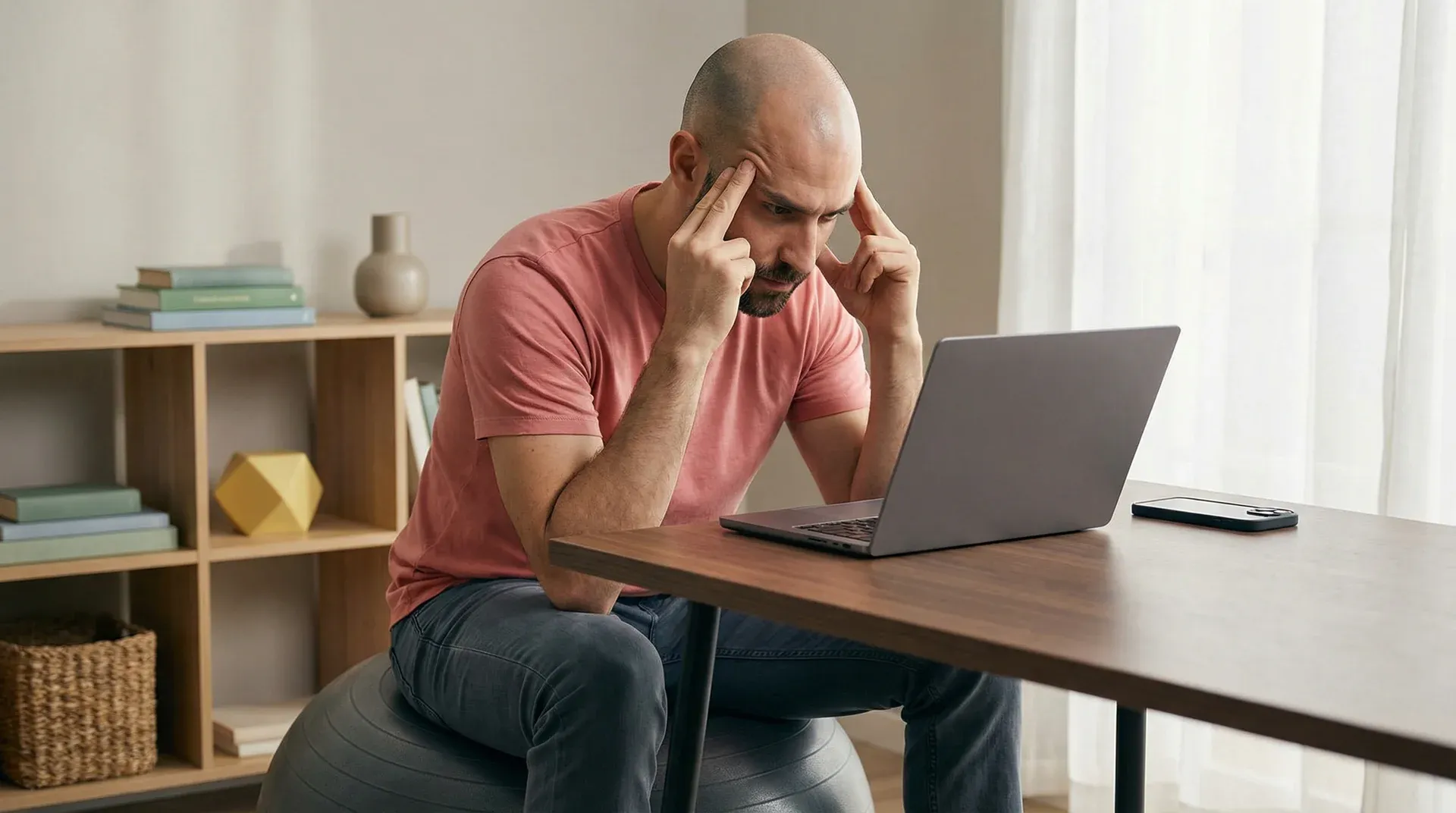
It starts behind your eyes. A dull pressure that was not there this morning.
By afternoon, it has spread to your temples. By evening, it is a full headache that makes you want to close your eyes and lie down.
You take a painkiller. It helps for a few hours. Tomorrow, the same headache comes back. Because you did not fix the cause. You treated the symptom.
The cause is staring at you right now.
How Screens Create Headaches
Screen headaches do not appear suddenly. They build. Layer by layer, hour by hour, until the pain crosses the threshold you can feel.
Understanding the 6 layers is the key to stopping them.
Reason 1: Eye Muscle Fatigue
This is the most common cause. And the most misunderstood.
Your eyes have tiny muscles called ciliary muscles that control focus. When you look at something close (like a screen), these muscles contract and hold. When you look at something far away, they relax.
During screen use, the ciliary muscles are locked in a contracted position for hours. They never get to relax. The fatigue builds the same way your arm would fatigue if you held a weight at shoulder height all day.
The American Optometric Association reports that digital eye strain affects the majority of people who use screens for more than two hours daily. The primary symptom is a headache that starts behind the eyes and spreads outward.
The pain is not in your head. It is in your eye muscles. And it radiates.
Reason 2: Blue Light Overstimulation
Blue light has a shorter wavelength and higher energy than other visible light. Every screen emits it. Your brain is especially sensitive to it.
Blue light excites retinal cells more intensely than other wavelengths. This overstimulation contributes to eye fatigue and can trigger headaches, particularly in people who are sensitive to light.
For people who experience migraines, blue light is a known trigger. Research from the American Academy of Ophthalmology confirms that while blue light does not cause permanent eye damage, it does contribute to discomfort and fatigue during extended screen use.
Blue light also suppresses melatonin, which disrupts sleep. Poor sleep lowers the headache threshold the next day. So the blue light from last night’s scrolling session contributes to today’s screen headache. For more on why screen time before bed sets up the following day for pain, see the full breakdown.
Reason 3: Poor Posture and Neck Tension
Look at how you are sitting right now.
If your head is tilted forward, your neck muscles are working overtime. The human head weighs about 10 to 12 pounds. For every inch it tilts forward, the effective weight on the neck doubles. At a 45-degree angle (common during phone use), the neck is supporting the equivalent of 50 pounds.
This sustained tension in the neck and shoulder muscles radiates upward. It reaches the base of the skull, the temples, and the forehead. The headache feels like it is coming from your head, but it is originating in your neck.
This type of headache is called a cervicogenic headache. It is caused by referred pain from the cervical spine and surrounding muscles. Screen use is one of the most common triggers because it encourages sustained forward head posture.
Reason 4: Dehydration
You have been staring at a screen for three hours. How much water have you had?
When you are absorbed in screen content, you forget to drink. The body’s thirst signals get overridden by the focus on the screen. Dehydration sets in gradually.
Even mild dehydration (1-2% of body weight) can trigger headaches. The brain is 75% water. When fluid levels drop, the brain temporarily contracts, pulling away from the skull. This triggers pain receptors and produces a headache.
Dehydration also thickens the blood, reducing oxygen delivery to the brain. The combination of reduced hydration and reduced oxygen creates the perfect conditions for a headache to develop.
The fix is simple. Drink water. But the problem is remembering to do it when the screen has captured your attention.
Reason 5: Screen Glare
Glare is light reflecting off the screen surface into your eyes. It forces the eye muscles to work harder to see through the reflected light, adding strain on top of the strain from sustained focus.
Glare is worst when the screen faces a window, when overhead lighting reflects off the display, or when the screen surface is glossy rather than matte.
You might not consciously notice glare. But your eyes do. They compensate by squinting slightly, adjusting focus constantly, and working harder to process the image. This additional effort compounds the fatigue from Reason 1 and accelerates the headache timeline.
Reason 6: Brightness Mismatch
If your screen is significantly brighter or dimmer than your surroundings, your eyes are constantly adjusting between two different light levels.
A bright screen in a dark room forces the pupils to constrict while the surrounding darkness tells them to dilate. This conflict creates strain. A dim screen in a bright room forces the eyes to squint and strain to see the content.
The ideal setup is a screen brightness that matches the ambient light in the room. When the two are balanced, the eyes can maintain a consistent state. When they are mismatched, the constant adjustment adds another layer of fatigue.
This is why headaches are often worse when scrolling in bed at night (bright screen, dark room) or working near a sunny window (bright environment, relatively dim screen).
Why the Headache Gets Worse Over the Week
Screen headaches are cumulative.
Monday, you feel fine until 4pm. Tuesday, the headache starts at 3pm. By Friday, it is there by noon. Each day, the eye muscles, neck muscles, and hydration levels start from a slightly worse baseline than the day before.
Sleep helps reset the system. But if you are scrolling before bed (disrupting sleep with blue light), the reset is incomplete. You wake up with a deficit. The headache starts building from a lower starting point.
This is why screen headaches often feel worst at the end of the work week and better after a weekend with less screen time. The pattern is predictable once you understand the accumulation. The same buildup drives dizziness from screen time, which frequently develops alongside headaches.
The Fix Is Not Painkillers
Painkillers treat the symptom. They do nothing about the 6 causes.
The fix is interrupting the accumulation before it reaches the pain threshold. That means breaks. Regular, consistent breaks that address multiple causes at once.
Movement breaks are the most effective because they solve several problems simultaneously. Standing up relieves neck tension. Walking changes focal distance and relaxes eye muscles. Moving increases blood flow and reminds you to drink water. Leaving the screen eliminates glare and brightness mismatch.
A 2-minute movement break every 30 minutes prevents the accumulation that causes the headache. The break does not need to be long. It needs to be consistent.
Making Breaks Happen Automatically
The problem is not knowing you need breaks. The problem is taking them.
When you are absorbed in work or scrolling, 30 minutes passes without a trace. The headache builds silently. By the time you notice it, the damage is done.
Scrolletics prevents this automatically. The app connects screen access to physical exercise. Before you can use distracting apps, you complete a short workout. Push-ups, squats, or planks. Your phone counts reps automatically using on-device camera detection. One rep earns one minute.
Every exercise session is a break that resets your eyes, your posture, your circulation, and your hydration awareness. The headache never builds because the cause keeps getting interrupted.
Stop Treating the Symptom
Screen headaches are not random. They are the predictable result of 6 causes working together over hours.
Eye muscle fatigue. Blue light. Poor posture. Dehydration. Glare. Brightness mismatch.
Each one is fixable. Together, they are preventable. The solution is not a pill. It is a pattern change.
Take breaks. Move your body. Drink water. Fix your lighting. Adjust your posture.
The headache is not the problem. It is the signal. And the signal is telling you that your screen routine needs to change.
Frequently Asked Questions
Can screen time cause headaches?
Yes. Screen time causes headaches through 6 mechanisms: eye muscle fatigue, blue light overstimulation, poor posture and neck tension, dehydration, screen glare, and brightness mismatch. The American Optometric Association reports that digital eye strain affects the majority of people who use screens for more than two hours daily. See also: is too much screen time bad for your eyes.
Why do I get headaches behind my eyes from screens?
Headaches behind the eyes are caused by ciliary muscle fatigue. These tiny muscles control focus and remain contracted during screen use. Hours of sustained contraction causes fatigue that radiates to the forehead and temples. The American Academy of Ophthalmology confirms that regular breaks are the most effective prevention.
How do I prevent headaches from screen time?
Take movement breaks every 20-30 minutes. Adjust screen brightness to match your environment. Position your screen at arm’s length. Stay hydrated. Reduce glare with proper lighting. Maintain good posture. Physical movement is the most effective prevention because it addresses eye strain, posture, dehydration, and muscle tension simultaneously. Learn more about symptoms of too much screen time and how to reduce screen time at work if the headaches are building during desk sessions.
What is Scrolletics and how does it prevent screen headaches?
Scrolletics builds automatic movement breaks into your screen routine. Before you can use distracting apps, you complete exercises like push-ups, squats, or planks. Your phone counts reps using on-device camera detection. One rep earns one minute. Every exercise session resets your eyes, posture, and circulation, preventing the tension that causes screen headaches. No recording, no uploads, fully private.