

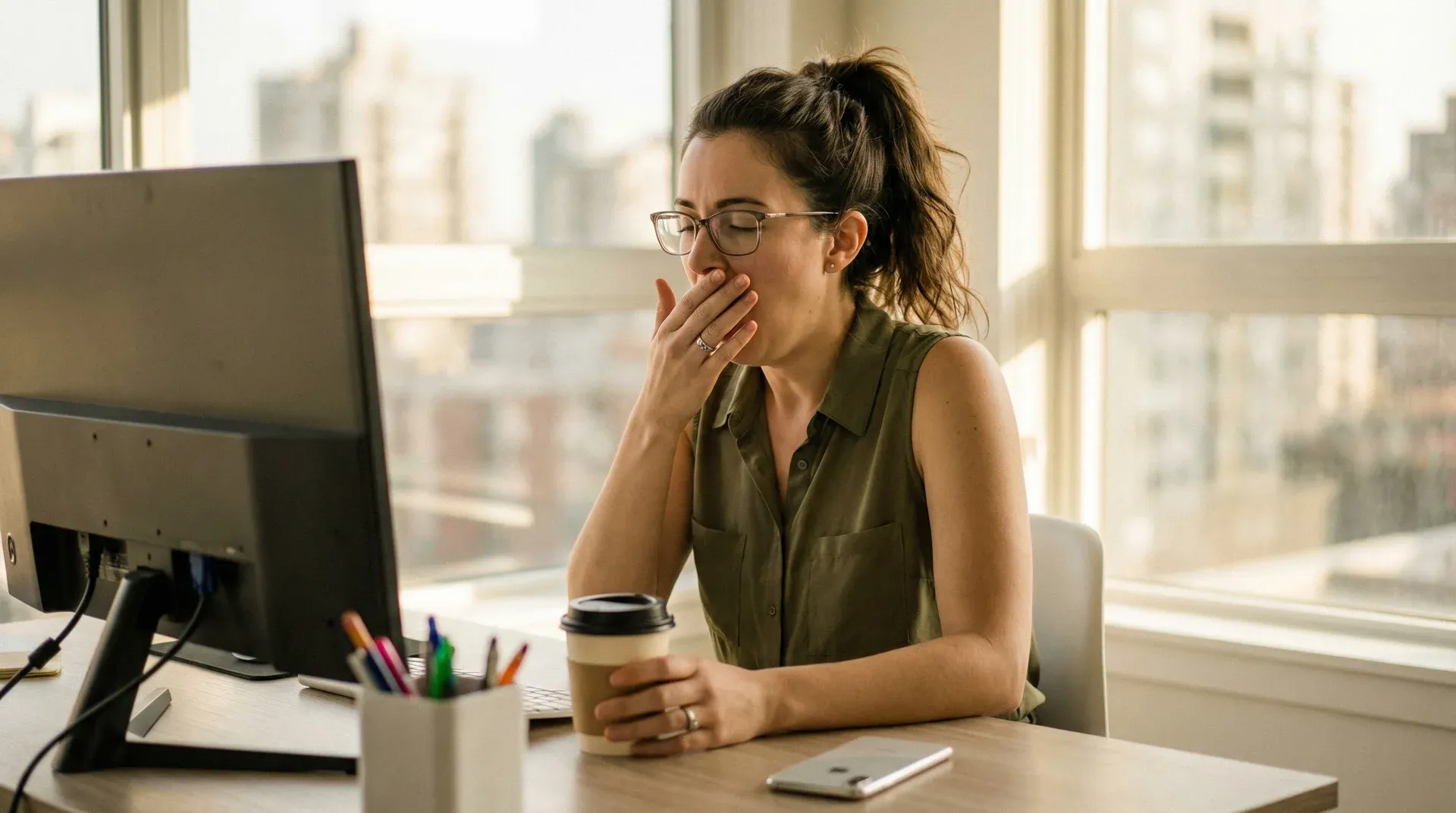
You slept 8 hours. You ate breakfast. You had coffee.
By 2pm, you are exhausted. Not sleepy. Exhausted. The kind of tired that sits behind your eyes and makes everything feel like effort.
You did not run a marathon. You did not do manual labor. You sat in front of a screen.
And that is exactly why you are tired.
Screen Fatigue Is Real
The tiredness you feel after hours of screen use is not in your head. It is a measurable physiological response to what screens do to your brain and body.
Most people assume screen fatigue is just about sleep. Blue light disrupts melatonin, you sleep poorly, you feel tired. That is part of it. But it is only one of 5 ways screens drain your energy.
The other 4 are happening right now, while you are awake, and they explain why you feel exhausted even on days when you slept well.
1. Your Brain Is Drowning in Information
Your brain has a processing budget. Every piece of information it takes in costs energy.
During screen use, the information flow is relentless. Scrolling through a social media feed, your brain processes hundreds of images, headlines, faces, and emotional cues per minute. Each one requires evaluation: Is this important? Is this threatening? Is this interesting? Should I respond?
Most of this processing happens below conscious awareness. You do not feel it happening. But your brain is working at full capacity, burning glucose and oxygen at an elevated rate.
After hours of this, the processing budget is spent. The brain signals fatigue the same way your legs signal fatigue after a long run. The mechanism is different. The exhaustion is equally real.
This is why you can feel mentally destroyed after a day of scrolling even though you did not do anything “productive.” Your brain did not rest. It processed thousands of inputs. The fact that none of them were important does not reduce the energy cost, which is also why heavy users notice gaps in recall, as covered in phone addiction and memory.
2. Blue Light Is Sabotaging Your Sleep Quality
You know blue light affects sleep. But the mechanism is more damaging than most people realize.
Blue light from screens suppresses melatonin production. The Harvard Health Blog confirms that blue light shifts the circadian rhythm and reduces both the duration and quality of sleep.
Here is the part that matters: you can sleep 8 hours and still not recover.
Melatonin does not just make you fall asleep. It regulates the architecture of sleep. How much time you spend in deep sleep versus light sleep. How much REM sleep you get. How effectively the brain clears metabolic waste during the night.
When melatonin is suppressed, you spend more time in light sleep and less time in the restorative stages. You wake up having slept for 8 hours but having recovered for 5.
The tiredness you feel the next morning is not from lack of sleep. It is from lack of quality sleep. And the screen you used before bed is the reason.
3. Your Body Is Not Moving
Sitting still for hours does not save energy. It drains it.
When you sit motionless in front of a screen, blood flow decreases. Circulation slows. Less oxygen reaches the brain. Less glucose is delivered to the cells that need it.
The brain consumes about 20% of the body’s total energy. When blood flow drops, the brain’s energy supply drops with it. The result is fatigue, brain fog, and difficulty concentrating.
Movement reverses this immediately. Even standing up and walking for 2 minutes increases blood flow, delivers oxygen, and restores alertness. Research from the British Journal of Sports Medicine confirms that brief bouts of physical activity improve cognitive function and reduce fatigue.
The irony is that the tiredness makes you less likely to move. You feel too exhausted to stand up. So you stay seated. Blood flow stays low. The fatigue deepens.
The screen creates the stillness. The stillness creates the fatigue. The fatigue prevents the movement that would fix it.
4. Your Eyes Are Exhausting Your Whole Body
Eye strain does not just cause headaches. It causes full-body fatigue.
The muscles that control focus are among the most active muscles in the body during screen use. They contract and hold for hours. The effort is invisible but constant.
When these muscles fatigue, the strain radiates. Tension spreads to the forehead, temples, neck, and shoulders. The body responds to this widespread tension by increasing cortisol, the stress hormone. Elevated cortisol over hours creates a state of low-grade stress that drains energy reserves.
The American Optometric Association reports that digital eye strain affects the majority of people who use screens for more than two hours daily. The symptoms include not just eye discomfort but fatigue, difficulty concentrating, and reduced productivity.
Your eyes are tired. And when your eyes are tired, your whole body feels it.
5. Dopamine Depletion Kills Your Motivation
This is the cause that nobody talks about.
Every scroll, every notification, every refresh triggers a small dopamine release. Over hours of screen use, the dopamine system becomes overstimulated. The receptors downregulate to compensate.
The result is dopamine depletion. The brain has used up its easily available dopamine on hundreds of tiny, meaningless rewards. When you finally need motivation for something real (cooking dinner, exercising, having a conversation), the tank is empty.
This is why screen fatigue feels different from physical fatigue. It is not just tiredness. It is a lack of motivation. Everything feels like too much effort. Not because you are physically incapable, but because the reward system that drives action has been drained.
As psychiatrist Anna Lembke explains in Dopamine Nation, chronic overstimulation tips the brain’s pleasure-pain balance. The brain compensates for excessive pleasure by creating a pain state. That pain state feels like fatigue, apathy, and an inability to enjoy anything.
The screen did not just tire you out. It temporarily broke the system that makes you want to do things.
Why It Gets Worse Over the Week
Screen fatigue is cumulative.
Monday, you feel fine until evening. By Wednesday, the fatigue starts at lunch. By Friday, you wake up already tired.
Each day, the sleep deficit compounds. The dopamine depletion deepens. The physical stillness accumulates. The eye strain carries over. The information overload never fully clears. Fatigue is one of the most consistent symptoms of too much screen time, and it is usually the last one people connect to their screens.
Weekends help, but only if you actually reduce screen time. If you spend Saturday and Sunday scrolling, the reset never happens. Monday starts from the same depleted baseline as Friday.
This is why people feel perpetually tired without an obvious cause. The cause is obvious. It is just so constant that it has become invisible.
The fatigue is not just daily. It is cumulative across your life. The Screen Time Calculator shows how many full days per year and years per lifetime your screen habit is consuming. When you see the number next to how you feel right now, the connection becomes impossible to dismiss.
The Fix Is Not More Sleep
More sleep helps. But it is not enough if the other 4 causes are still running.
You need movement during the day to restore blood flow. You need breaks from information processing to let the brain recover. You need screen-free time to let the dopamine system rebalance. You need to address eye strain before it compounds.
The most effective intervention is regular movement breaks. Movement addresses causes 3, 4, and 5 simultaneously. It restores blood flow. It relieves eye strain by changing focal distance. It provides dopamine through a healthy pathway that does not deplete the system.
Even 2 minutes of movement every 30 minutes changes the equation. The fatigue never builds to the point of exhaustion because the causes keep getting interrupted.
Making the Breaks Happen
You know you need breaks. You will not take them consistently. Not because you do not care, but because the screen absorbs your attention and the time disappears.
Scrolletics solves this. The app connects screen access to physical exercise. Before you can use distracting apps, you complete a short workout. Push-ups, squats, or planks. Your phone counts reps automatically using on-device camera detection. One rep earns one minute.
Every exercise session restores blood flow, resets the dopamine system, relieves eye strain, and interrupts the information overload. The fatigue never accumulates because the pattern keeps getting broken.
You Are Not Lazy
If you feel exhausted after a day of screen use, you are not lazy. You are drained.
Five forces have been working against your energy all day. Information overload. Sleep disruption. Physical stillness. Eye strain. Dopamine depletion.
None of them are visible. All of them are real.
The fix is not willpower. It is not more coffee. It is changing the pattern that creates the drain.
Move more. Screen less. Sleep without blue light. Take breaks before the fatigue builds.
The energy is not gone. It is being stolen. And now you know where it is going.
Frequently Asked Questions
Why does screen time make me so tired?
Screen time causes fatigue through 5 mechanisms: mental exhaustion from constant information processing, blue light disruption of sleep quality, physical stillness reducing blood flow, eye strain draining energy, and dopamine depletion killing motivation. These effects compound throughout the day. The Harvard Health Blog confirms that blue light alone significantly reduces sleep quality. Fatigue and screen time headaches often develop together, driven by the same accumulation. See also: screen time before bed.
Can screen time make you tired even if you sleep enough?
Yes. Blue light reduces sleep quality even when duration is adequate. You may sleep 8 hours but spend less time in restorative deep sleep and REM sleep. Mental fatigue from information overload also persists through sleep if the overload is chronic. Learn more about the effects of excessive screen time.
How do I stop feeling tired from screen time?
Take movement breaks every 30 minutes. Stop screen use at least one hour before bed. Reduce total recreational screen time. Stay hydrated. Alternate between screen and non-screen activities. The British Journal of Sports Medicine confirms that even brief physical activity improves cognitive function and reduces fatigue. See also: how to reduce screen time.
What is Scrolletics and how does it help with screen fatigue?
Scrolletics builds movement breaks into your screen routine by connecting screen access to physical exercise. You do push-ups, squats, or planks, and your phone counts reps using on-device camera detection. One rep earns one minute. Every exercise session restores blood flow, resets the brain, and prevents the fatigue that builds from prolonged screen use. No recording, no uploads, fully private.