

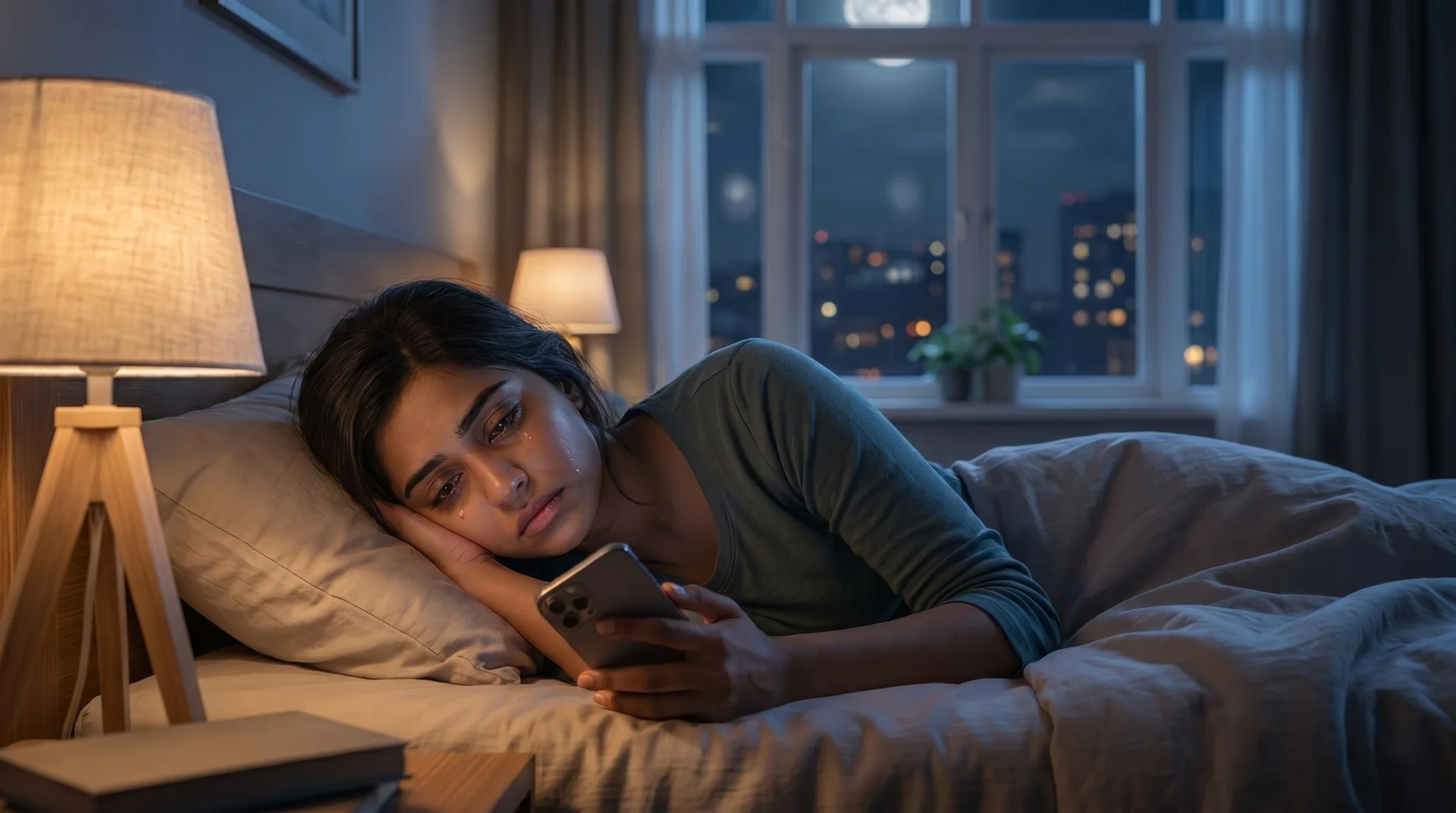
You have 800 followers and nobody to call.
The phone promised to connect you to everyone. Instead, it replaced the few deep connections you had with hundreds of shallow ones. You are more “connected” than any generation in history and lonelier than most.
This is not a coincidence. It is a consequence. A study published in Frontiers in Psychology found that loneliness directly predicts phone addiction severity. And phone addiction, in turn, deepens loneliness. The relationship is bidirectional: each one feeds the other.
Here are 5 reasons your phone is making you lonelier, and why the solution requires more than putting it down.
1. Social Snacking Replaces Real Meals
Your brain has a social need. It requires genuine human connection the way it requires food: not just the feeling of eating, but actual nutrition.
Social media provides what researchers call social snacking, brief digital interactions that create the sensation of social activity without the substance. A like. A comment. A quick DM. Each one registers as a social interaction, triggering a small dopamine response that temporarily satisfies the urge to connect.
But social snacking is to real connection what a bag of chips is to a meal. It fills the immediate craving without providing what the brain actually needs: depth, vulnerability, presence, sustained attention from another person.
The problem is not that social snacking exists. It is that it replaces the meal. When the urge to connect arises, you open Instagram instead of calling a friend. The urge is temporarily satisfied. The underlying need is not. Over time, the gap between perceived social activity and actual social fulfillment grows wider.
You feel like you are socializing. You are not. You are snacking. And the hunger keeps growing.
2. Parasocial Relationships Feel Real but Are Not
You follow someone. You watch their stories. You know about their life, their opinions, their daily routine. You feel like you know them.
You do not.
Parasocial relationships are one-sided connections where one person invests emotional energy in someone who does not know they exist. They have always existed in the context of celebrities and television personalities. Social media has made them universal.
When you follow a creator, your brain processes the relationship using the same social circuits it uses for real friendships. The content feels personal. The tone feels intimate. The updates feel like communication. But the relationship has no reciprocity. The other person does not know your name, has never heard your voice, and would not recognize you in a room.
Research published by the American Psychological Association links heavy social media use to increased feelings of social isolation despite high levels of perceived connectivity. Parasocial relationships are a primary driver of this paradox. They create the feeling of connection while displacing the time and energy that real connection requires.
The brain cannot distinguish between authentic and parasocial connection in the moment. But the emotional nutrition is not the same. You end a scroll session feeling like you spent time with people. You did not. You spent time with performances.
3. Phubbing Erodes the Relationships You Already Have
The loneliness is not only about missing connections you do not have. It is about degrading the ones you do.
Phubbing, the act of snubbing someone in favor of your phone, does not just damage relationship satisfaction. It manufactures loneliness from the inside of an existing relationship. Research at Baylor University found that partner phubbing increases conflict and contributes to depression in the person being ignored.
The damage happens in micro-moments. Checking the phone during dinner. Scrolling while someone is talking. Glancing at a notification mid-conversation. Each instance is small. The accumulation is significant.
The person being phubbed gradually stops sharing, stops initiating, and stops expecting presence. They withdraw. The phone-addicted person barely notices because the phone provides enough social stimulation to mask the growing distance. By the time the withdrawal becomes visible, both people are lonelier than before, one from being ignored and the other from losing a connection they did not realize they were hollowing out.
This is the mechanism that makes phone-driven loneliness especially cruel. You are not just failing to find connection. You are eroding the connections you already have, one glance at the screen at a time.
4. The Loneliness-Scrolling Cycle Is Self-Reinforcing
Loneliness creates an urge to connect. The phone is the easiest way to satisfy that urge. You scroll. The temporary social stimulation numbs the loneliness. Then it passes. The loneliness returns, often worse than before because the scrolling consumed time you could have spent on real interaction.
A study published in PMC found a significant positive association between loneliness and phone addiction among college students. Lonelier individuals showed stronger tendencies toward phone dependence, and phone dependence further weakened their real-world interpersonal skills.
The cycle operates below conscious awareness. You do not think, “I am lonely, so I will open my phone.” The behavior is automatic. Loneliness triggers discomfort. The hand reaches for the phone. The scroll begins. The discomfort temporarily subsides. The cause of the discomfort, genuine disconnection, remains unchanged.
This is the compensatory internet use pattern described in addiction research. The phone serves as an emotional escape mechanism. It temporarily frees you from the feeling of loneliness without addressing its source. The relief is real. The solution is counterfeit. And the counterfeit solution prevents the real solution from ever being pursued.
5. Online Connection Satisfies the Urge but Not the Need
There is a difference between social contact and social nourishment.
A text exchange provides contact. A face-to-face conversation provides nourishment. A comment on a post provides contact. A shared experience provides nourishment. The brain responds to both, but the long-term effects are opposite.
Research consistently shows that people who rely primarily on digital communication for social interaction report higher levels of loneliness than people who maintain face-to-face relationships, even when the total amount of social contact is similar.
The difference is presence. Real conversation involves tone of voice, facial expression, body language, physical proximity, and the unpredictability of genuine human interaction. Digital communication strips most of this away. What remains is a compressed, controlled, asynchronous version of connection that activates the social circuits without delivering the full experience.
You can spend 3 hours texting and commenting and still go to bed feeling alone. You can spend 30 minutes with a friend and feel connected for days. The quantity of digital interaction does not compensate for the quality of real interaction. The brain knows the difference even when you do not.
What Reverses the Pattern
The loneliness-scrolling cycle does not break by trying harder. It breaks by changing the structure.
Call instead of text. Voice conversation activates social circuits that text cannot reach. The effort of calling feels higher, which is exactly why it works better. Real connection requires effort. The phone trained you to avoid effort. Reversing that is the starting point.
Leave the phone behind. When you meet someone for coffee, leave the phone in the car. When you eat dinner with family, put the phone in another room. Removing the escape hatch forces genuine presence. The conversation will be awkward for the first few minutes. Then it will be better than anything on your feed.
Join a recurring activity. A weekly class, a sports league, a volunteer shift, a book club. Loneliness thrives in unstructured time because unstructured time defaults to scrolling. Recurring commitments create social contact that does not depend on motivation or initiative. The structure does the work.
Replace the bedtime scroll with a phone call. The loneliest time of day is usually right before sleep. That is also when most people scroll the longest. Calling a friend or family member for 10 minutes before bed replaces the emptiest screen time with the most meaningful human contact.
Move your body. Exercise reduces loneliness through multiple pathways. It releases endorphins that improve mood. It often happens in social settings. And it fills the time that scrolling would otherwise consume. A study published in the Journal of Psychiatric Research found that regular physical activity is significantly associated with reduced feelings of loneliness.
This is the foundation of Scrolletics. The app connects screen access to physical exercise. Push-ups, squats, or planks. Your phone counts reps automatically using on-device camera detection. One rep earns one minute of screen time.
The movement creates the neurochemical shift that loneliness needs. The reduced phone use creates the space that real connection requires. The structure addresses both sides of the cycle simultaneously.
Want to see what the scrolling is costing in time? The Screen Time Calculator shows how many days and years your current usage adds up to. That time is time not spent with people who matter.
The Phone Cannot Give You What You Actually Need
Five reasons. All documented. All operating every time you open your phone to fill the gap.
Your phone is not the cause of your loneliness. But it is the most effective obstacle to solving it. Every hour spent scrolling is an hour not spent building the real connections that would actually help.
The paradox is painful: the lonelier you feel, the more you reach for the phone. The more you reach for the phone, the lonelier you become. The cycle does not resolve on its own.
Start with one change. One phone call instead of a text. One dinner without the phone on the table. One evening where the screen stays dark and the conversation continues.
Connection is not measured in followers. It is measured in presence. And presence requires putting the phone down.
Frequently Asked Questions
Does phone addiction make you lonely?
Yes. Research consistently shows a bidirectional relationship between phone addiction and loneliness. A study published in Frontiers in Psychology found that loneliness predicts phone addiction, and phone addiction deepens loneliness by replacing real connection with shallow digital interaction. For the relationship-specific damage, see phone addiction and relationships.
Why does social media make me feel more alone?
Social media provides social snacking, brief interactions that satisfy the urge to connect without meeting the need for depth and presence. Parasocial relationships create the feeling of friendship without reciprocity. Over time, digital interaction replaces rather than supplements real-world connection. See also: effects of social media addiction and how to take a social media break.
How do I stop using my phone when I am lonely?
Replace the phone with something that addresses the actual need. Call someone instead of texting. Leave the phone behind during social activities. Move your body. Physical activity reduces loneliness through neurochemical effects and creates time for real interaction. For structured approaches, see how to reduce screen time and screen time addiction treatment.
What is Scrolletics and how does it help with phone-driven loneliness?
Scrolletics inserts physical exercise before screen access. You do push-ups, squats, or planks, and your phone counts reps automatically using on-device camera detection. One rep earns one minute of screen time. Exercise reduces loneliness directly through neurochemical effects and indirectly by creating space for real-world connection. No recording, no uploads, fully private.