

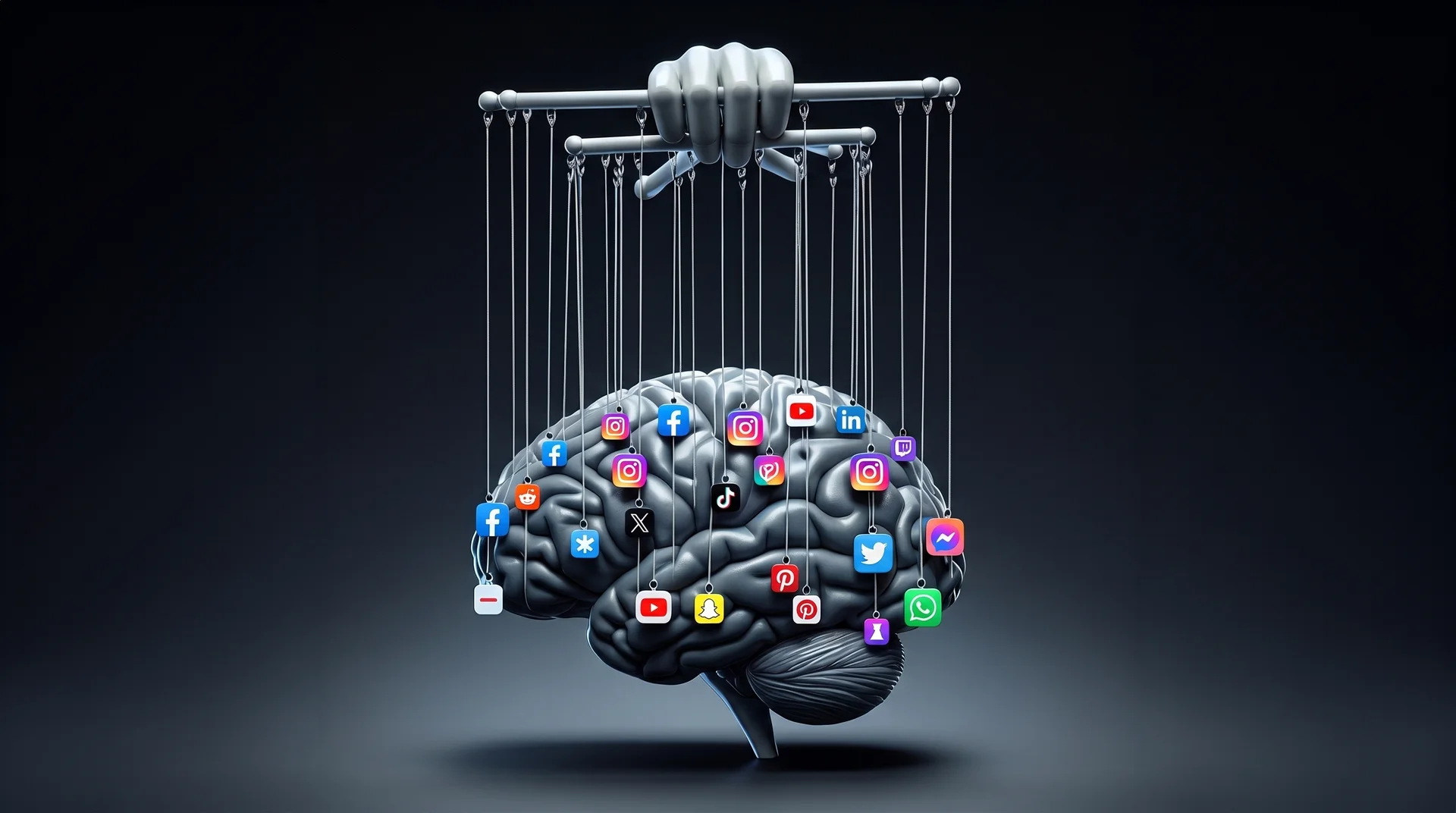
Social media addiction does not just steal your time. It changes your brain.
The effects are not obvious while you are inside the habit. You do not notice the anxiety building. You do not feel the attention span shrinking. You do not see the relationships thinning. The changes happen gradually, below the threshold of daily awareness, until the damage has accumulated enough to become visible.
By then, the habit is deeply wired. The effects and the addiction feed each other in ways you can feel but cannot always name.
Here are 8 effects of social media addiction. All backed by research. Each one explains not just what is happening, but why it keeps getting worse.
Effect 1: Your Dopamine System Gets Rewired
Every like. Every comment. Every new follower. Each one triggers a small burst of dopamine. The brain’s reward system registers it the same way it registers food, connection, or accomplishment.
The problem is not the dopamine itself. The problem is the volume and speed. Social media delivers rewards faster and more frequently than any natural behavior. Over time, the brain recalibrates. The baseline shifts. Activities that used to feel rewarding, like reading, cooking, or conversation, begin to feel flat by comparison.
Research from the National Institute on Drug Abuse confirms that behavioral addictions reshape the dopamine system in the same way substance addictions do. The brain adapts to the flood of easy rewards by raising the bar. It needs more stimulation to feel the same level of satisfaction. Normal life starts to feel dull.
This is why you can scroll for an hour, see nothing memorable, and still feel compelled to keep scrolling. The brain is chasing a reward it has already become desensitized to.
Effect 2: Anxiety Increases
Social media does not just correlate with anxiety. It feeds it.
The American Psychological Association links heavy social media use to increased stress and anxiety symptoms. The mechanisms are multiple: constant social comparison, exposure to conflict and negativity, fear of missing out, notification-driven urgency, and the loss of genuine downtime.
Your nervous system stays in a state of low-grade activation. The phone might buzz at any moment. Someone might comment on your post. A conflict might erupt in a group chat. The brain stays vigilant, and vigilance over time becomes anxiety.
The relationship is bidirectional. Anxiety drives you to the phone for relief. The phone temporarily numbs the anxiety. Then it makes it worse. The cycle tightens with each rotation.
Effect 3: Self-Image Distorts
You are not comparing yourself to real people. You are comparing yourself to curated performances of real people.
Social media shows you the best version of everyone else’s life: the vacation photos, the achievement posts, the carefully filtered selfies. Your brain processes these as reality even when you know intellectually that they are selected highlights.
A study published in JAMA Pediatrics found that social media use is associated with increased body dissatisfaction, lower self-esteem, and disordered eating behaviors, particularly among adolescents. The effect is not limited to teens, though it hits them hardest, which is why we cover social media addiction in teens separately. Adults who use social media heavily report similar patterns of comparison-driven dissatisfaction.
The distortion is subtle but persistent. Over months and years, the gap between your actual life and the curated lives on your feed creates a chronic sense that you are not enough. Not attractive enough. Not successful enough. Not interesting enough.
This feeling drives more social media use. More scrolling. More comparison. More inadequacy. The effect creates the behavior that deepens the effect.
Effect 4: Relationships Deteriorate
Social media promises connection. It delivers isolation. Our deeper look at phone addiction and loneliness traces how this paradox plays out day to day.
The conversations happening in comments and DMs feel like social interaction. But they lack the depth, nuance, and presence that real relationships require. You can have 1,000 followers and still feel lonely. The number of connections has no relationship to the quality of connection.
A Baylor University study found that phone use during face-to-face interactions directly reduces relationship satisfaction. Partners who feel “phubbed” (phone-snubbed) report more conflict, less trust, and lower overall satisfaction.
The damage is not dramatic. It is erosive. Thousands of small moments where someone was present in the room but absent in attention. Over months, the relationship becomes a backdrop to individual scrolling rather than a source of genuine connection.
If you are spending more time on social media than in face-to-face conversation with the people who matter to you, the effect is already underway.
Effect 5: Your Attention Span Gets Retrained by Algorithms
Social media does not just compete for your attention. It actively reshapes how your attention works.
Algorithmic feeds are designed to serve the next piece of content before you finish processing the current one. TikTok auto-plays the next video before you decide to keep watching, which is why TikTok addiction has become a category of its own. Instagram surfaces stories, reels, and suggested posts in rapid succession. The algorithm learns your preferences and exploits them, creating a content stream optimized to keep you scrolling, not thinking.
The result is a brain trained on someone else’s schedule. You lose the ability to direct your own attention because the algorithm has been directing it for you. Reading a book requires self-directed focus. Social media never asks for it.
A study published in Nature Communications found that collective attention spans are narrowing as the volume and speed of content increases. The effect is not just individual. It is cultural. Social media is training an entire population to consume faster and reflect less.
If you struggle to sit with a long article, a conversation, or your own thoughts without reaching for your phone, this is why. Your attention was not lost. It was retrained by platforms that profit from keeping it fragmented.
Effect 6: Sleep Becomes Collateral Damage
Social media ruins sleep in ways that screens alone do not.
Blue light from any screen suppresses melatonin. But social media adds layers of disruption that a movie or an e-book does not. A feed is unpredictable. You do not know when the interesting content will appear, so you keep scrolling. A group chat might blow up at midnight. A comment on your post might demand a response. The Harvard Health Blog confirms the circadian disruption from screen light, but social media compounds it with emotional activation and social obligation that keep the brain alert.
The fear of missing out is strongest at night. The quiet of the bedroom amplifies the pull of the feed. Putting the phone down feels like disconnecting from your social world, and the anxiety that creates is specific to social media. Nobody lies awake worrying about missing a weather update.
The sleep debt compounds. Mood suffers. Concentration declines. Emotional regulation weakens. And the response to all of these problems is often more scrolling, which makes the sleep problem worse.
Effect 7: Your Body Pays for What Your Brain Consumes
Social media addiction creates a specific physical profile that goes beyond simple inactivity.
Stress hormones stay elevated. Cortisol spikes from negative interactions, social comparison, and doomscrolling do not dissipate the way they would from a real-world stressor. A face-to-face argument resolves. An online comment thread does not. The stress lingers because the feed never ends. A study published in Psychoneuroendocrinology found that cortisol levels are correlated with frequency of social media checking.
Posture deteriorates from the specific position social media demands: hunched over a phone, neck angled down, shoulders rolled forward. This is not the posture of someone working at a computer. It is the posture of someone curled around a small screen for hours.
Appetite and eating patterns shift. Social media exposes users to constant food content, body comparison, and time distortion that disrupts regular meal patterns. Research links heavy social media use to both overeating and restrictive eating behaviors.
Fatigue accumulates not from physical effort but from cognitive overload. Processing an endless feed of faces, text, video, and emotional content drains energy in ways that sleep does not fully restore. The tiredness is real. It is just not the kind that rest fixes.
Effect 8: Emotional Regulation Weakens
Social media becomes the default response to every uncomfortable emotion. Bored? Scroll. Stressed? Scroll. Sad? Scroll. Anxious? Scroll.
When social media replaces healthy coping mechanisms, the ability to process emotions without a screen deteriorates. The brain never learns to sit with discomfort because the phone is always available to numb it.
Over time, this creates emotional fragility. Small frustrations feel overwhelming because the skill to manage them was never developed. Boredom feels intolerable because it was always immediately medicated with content. Sadness deepens because it was never processed, just buried under a feed.
This effect is especially damaging for adolescents, whose emotional regulation skills are still developing. But adults are not immune. Any brain that consistently avoids emotional discomfort by reaching for a screen will lose the capacity to manage that discomfort without one.
Why These Effects Compound
These 8 effects do not operate in isolation. They reinforce each other.
Dopamine rewiring makes you use social media more. More use increases anxiety. Anxiety disrupts sleep. Poor sleep weakens emotional regulation. Weak emotional regulation drives you back to the phone. More phone use deteriorates relationships. Relationship problems increase stress. Stress drives more scrolling.
Each effect feeds the next. The cycle accelerates over months and years unless something disrupts it.
The compound nature of these effects is why willpower-based solutions rarely work. You are not fighting one problem. You are fighting 8 interconnected problems that strengthen each other with every cycle.
Breaking the pattern requires changing the system, not just the intention.
What Reverses the Damage
The brain is neuroplastic. The effects of social media addiction are real, but they are not permanent if the behavior changes.
Movement is the most effective counterforce. Physical activity provides dopamine through a healthier pathway. It improves sleep. It reduces anxiety. It strengthens emotional regulation. It creates natural breaks from the screen.
Real-world connection reverses the relationship deterioration. Face-to-face conversations rebuild the social skills that screen-based interaction eroded.
Boredom tolerance returns when you stop medicating boredom with content. The first few days are uncomfortable. Then the brain begins to generate its own ideas, creativity, and motivation again.
This is the foundation of Scrolletics. The app connects screen access to physical exercise. Push-ups, squats, or planks unlock screen time. One rep earns one minute. Your phone counts reps automatically using on-device camera detection.
Every effect described in this article is directly counteracted by the system. Movement replaces sedentary scrolling. Effort replaces compulsive checking. The dopamine comes from physical accomplishment instead of algorithmic stimulation.
Want to see what your current social media habit is costing in time? The Screen Time Calculator converts daily hours into lifetime days and years. The number makes the effects tangible.
The Effects Are Real. So Is the Way Out.
Eight effects. All documented. All measurable. All currently operating in the background of your daily life if social media has become compulsive.
The damage is not dramatic. It is gradual. That is what makes it dangerous. By the time the effects are obvious, the habit is deeply wired.
But the brain rewires in both directions. Change the behavior and the effects begin to reverse. Sleep improves first. Then mood. Then focus. Then relationships. The timeline depends on the severity of the habit, but the direction is consistent.
Start with one change. One phone-free hour. One evening without scrolling. One morning where movement comes before the feed.
The effects accumulated over time. They reverse the same way.
Frequently Asked Questions
What are the main effects of social media addiction?
Social media addiction produces 8 documented effects: dopamine system rewiring, increased anxiety, distorted self-image, relationship deterioration, algorithmic retraining of attention, social-media-specific sleep disruption, stress hormone elevation and physical symptoms, and weakened emotional regulation. These effects compound over time and reinforce each other. For the broader picture, see effects of excessive screen time and screen time and mental health.
Does social media addiction cause depression?
Research strongly supports a bidirectional link. The American Psychological Association reports that heavy social media use is associated with increased depressive symptoms. Social comparison, sleep disruption, and reduced real-world activity all contribute. Depression also drives more social media use as a coping mechanism. For the anxiety connection specifically, see screen time and anxiety.
Can social media addiction be reversed?
Yes. The brain is neuroplastic. Reducing social media use and replacing it with physical activity, real-world connection, and offline hobbies begins to reverse the effects within weeks. The dopamine system recalibrates. Sleep improves. Anxiety decreases. The first 7 to 14 days are the hardest. See also: how to take a social media break and what happens when you reduce screen time.
What is Scrolletics and how does it help reverse the effects of social media addiction?
Scrolletics addresses the root structure of social media addiction by connecting screen access to physical exercise. You do push-ups, squats, or planks, and your phone counts reps automatically using on-device camera detection. One rep earns one minute of screen time. This provides dopamine through movement instead of scrolling, directly counteracting the brain rewiring that addiction creates. No recording, no uploads, fully private.