

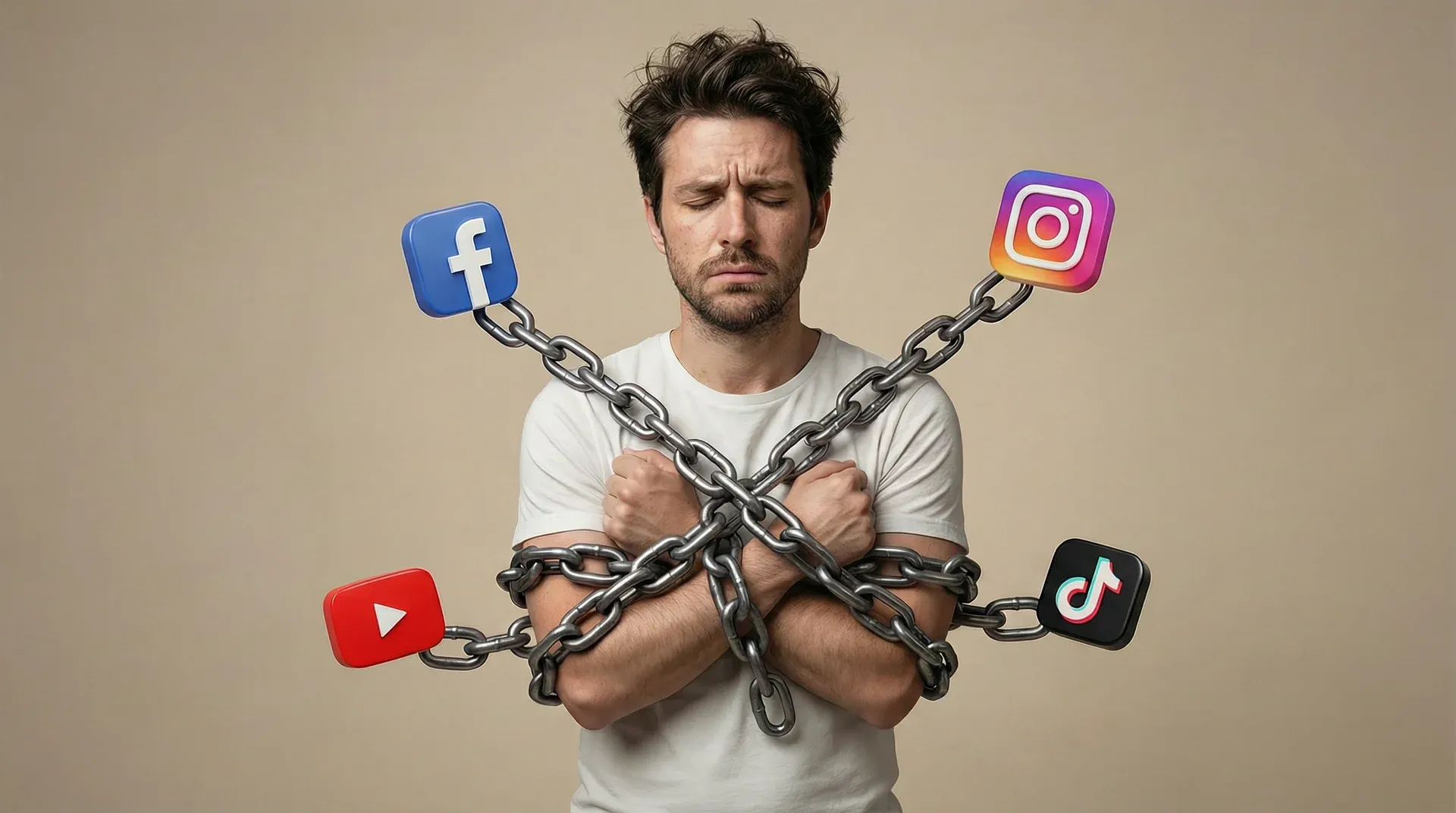
You have tried this before.
You deleted Instagram. Maybe TikTok too. You felt great for a day or two. Then the boredom hit. The FOMO crept in. You reinstalled the app “just to check one thing.”
Within a week, you were back to the same pattern.
That is not a failure of willpower. That is a failure of strategy.
Most advice about social media breaks focuses on removal: delete the app, log out, turn off notifications. Removal is the easy part. It is what comes after that determines whether the break works or collapses.
Here are 7 steps that make a social media break actually stick.
Step 1: Know Why You Are Taking the Break
“I should use social media less” is not a reason. It is a vague intention, and vague intentions do not survive the first wave of boredom.
Get specific. What is social media actually costing you?
Maybe it is sleep. You scroll until midnight and wake up exhausted. Maybe it is focus. You cannot work for 20 minutes without checking your phone. Maybe it is mood. You feel worse after every session but keep going back.
Write down the specific problem. Put it somewhere you will see it during the break. When the urge to reinstall hits (and it will), that reason is what keeps you going.
The American Psychological Association reports that social media use is associated with increased anxiety, depression, and sleep disruption. Your reason does not need to be dramatic. It just needs to be real.
Step 2: Choose Your Level
This is not all-or-nothing. That thinking is what makes people avoid breaks entirely.
Choose the level that matches your situation.
Full break. Delete all social media apps. Log out of all accounts on your browser. No checking, no posting, no lurking. This is the most effective option for people whose use has become compulsive.
Selective break. Remove only the apps that cause the most damage. If Instagram is the problem but you need LinkedIn for work, keep LinkedIn and delete Instagram. Target the specific habit instead of all digital communication.
Time-limited break. Keep the apps but restrict when you can use them. No social media before noon. No social media after 8pm. No social media during meals. This works best for people who need to maintain some presence for professional reasons.
Weekend break. Social media is allowed on weekdays but not on weekends (or the reverse). This creates regular reset periods without requiring a complete shutdown.
Pick one. Commit to it for a specific duration. Seven days minimum. Thirty days if you can.
Step 3: Tell People Before You Disappear
If social media is how people reach you, disappearing without warning creates problems.
Send a quick message to the people who matter: “I am taking a break from social media for the next [duration]. Text me or call me if you need to reach me.”
This does three things. It prevents worry. It creates accountability. And it forces you to identify who you actually talk to through social media versus who you just passively observe.
Most people discover the number is much smaller than they assumed.
Step 4: Remove the Triggers
Here is what most people get wrong. They delete the app and call it done.
The app is not the trigger. The trigger is the moment of boredom, stress, or emptiness that makes your hand reach for the phone. If the triggers remain, the habit finds a way back.
Turn off all notifications. Not just social media notifications. All of them. Every notification is a potential trigger that pulls you back to the phone.
Move your phone. If you usually scroll on the couch, do not sit on the couch with your phone nearby. If you scroll in bed, charge your phone in another room.
Log out of browser versions. Deleting the app means nothing if you can open Safari and type the URL. Log out of every account on every browser.
Remove bookmarks and shortcuts. Any path that makes it easy to access social media needs to be blocked or removed.
The goal is friction. Every barrier gives your conscious mind time to intervene before the habit takes over.
Before you start, see what you stand to reclaim. The Screen Time Calculator shows how many days per year and years per lifetime your current social media hours are consuming. That number makes the break feel less like sacrifice and more like recovery.
Step 5: Fill the Gap Before It Opens
This is where most breaks collapse.
Social media fills time. When you remove it, that time becomes empty. Empty time plus boredom equals reinstalling the app.
You need replacements ready before the break starts. Not vague ideas. Specific alternatives you can reach for without thinking.
For the morning scroll: Put a book on your nightstand. When you wake up and reach for your phone, the book is there instead.
For the boredom scroll: Have a list of 5-minute activities visible. A short walk. A few pages of reading. A quick stretch. Ten push-ups. The activity does not need to be impressive. It needs to be available.
For the stress scroll: Identify one physical action you can do when stress hits. A walk around the block. A set of squats. Deep breathing. The replacement needs to meet the same need social media was meeting: distraction from discomfort.
For the social scroll: Schedule real interactions. Call a friend. Meet someone for coffee. Send a text instead of checking a feed. Real connection satisfies the need that social media only pretends to meet.
The first 48 hours are the hardest. Have replacements ready and you can survive them. After that, the urge weakens faster than you expect.
Step 6: Track What Changes
Your brain will try to convince you the break is not working. It is wrong.
During the break, pay attention to what actually shifts.
Sleep. Are you falling asleep faster? Sleeping longer? Waking up more rested?
Mood. Do you feel less anxious? Less irritable? More present?
Time. How much free time appeared? What did you do with it?
Focus. Can you read for longer? Work without interruption? Follow a conversation without checking your phone?
Relationships. Are conversations deeper? Are you more present with the people around you?
Write these down. They become your evidence.
When the break ends and the temptation to return appears, these notes remind you what you gained. And what you would lose.
The effects of social media are invisible while you are inside the habit. They become obvious the moment you step outside it.
Step 7: Build a System for After the Break
The break ends. Now what?
This is the step that separates a temporary reset from a permanent change.
If you go back to the same setup, the old pattern returns within days. Same apps. Same notifications. Same triggers. The clarity fades. You end up planning another break a few months later.
A successful break changes the default. Not just the duration.
Reinstall selectively. Do not put every app back. Only reinstall the ones that genuinely add value. If you did not miss an app during the break, you do not need it.
Set permanent boundaries. No social media in the bedroom. No social media during meals. No social media in the first hour after waking. These rules outlast the break.
Use friction permanently. Keep notifications off. Keep apps off the home screen. Log out after each session so returning requires effort.
Schedule social media time. Instead of checking whenever the urge hits, designate specific times. Twice a day for 15 minutes each. This transforms the habit from compulsive to intentional.
Replace the habit permanently. The replacements you used during the break should become your new defaults. Movement before scrolling. Books before feeds. Conversations before comments.
Why Movement Makes the Break Stick
Physical movement is the most effective replacement for social media. Not because someone told you exercise is healthy. Because it meets the exact same needs.
Social media provides stimulation. Movement provides it through the body instead of the screen.
Social media provides stress relief. Temporarily. Movement provides stress relief that actually lasts.
Social media provides dopamine. Movement provides dopamine through a pathway that builds you up instead of wearing you down.
When movement becomes the default response to boredom or stress, the pull of social media weakens. Permanently.
This is where Scrolletics helps. The app connects screen access to physical exercise. Short workouts like push-ups, squats, or planks unlock screen time. One rep earns one minute. Your phone counts reps automatically using on-device camera detection.
Instead of relying on willpower to stay off social media, the system makes movement the gateway. The habit changes at the structural level, not just the motivational level.
The Break Is Just the Beginning
A social media break shows you what life looks like without the noise. Better sleep. Better mood. More time. More presence.
But the break is temporary. What you build after it is what lasts.
Follow the 7 steps. Know your reason. Choose your level. Tell people. Remove triggers. Fill the gap. Track the changes. Build the system.
The first 48 hours are the hardest. Everything after that gets easier.
The version of your life on the other side of the break is worth the discomfort of getting there.
Frequently Asked Questions
How long should a social media break last?
A meaningful social media break should last at least 7 days. Shorter breaks provide temporary relief but rarely change the underlying habit. As psychiatrist Anna Lembke explains in Dopamine Nation, the dopamine system needs several days to begin recalibrating. A 30-day break provides the most significant results. See also: screen time detox for adults.
What happens when you take a break from social media?
The first 48 hours are the hardest. You will feel restless, bored, and tempted to check. By day 3-4, the urge weakens. By the end of the first week, most people report better sleep, improved mood, more free time, and greater presence in conversations. The American Psychological Association confirms that reduced social media use is associated with lower anxiety and depression.
Why do most social media breaks fail?
Most breaks fail because people remove the app without replacing the habit. Social media fills specific needs: stimulation, connection, stress relief, boredom management. When those needs go unmet, the urge to return becomes overwhelming. A successful break requires planning what will fill the gap before the break begins. Learn more about how to reduce screen time.
What is Scrolletics and how does it help during a social media break?
Scrolletics replaces the social media habit with physical movement. Instead of scrolling when bored or stressed, you do exercises like push-ups, squats, or planks. Your phone counts reps automatically using on-device camera detection. One rep earns one minute of screen time. This fills the gap that social media leaves and builds a healthier habit in its place. No recording, no uploads, fully private.