

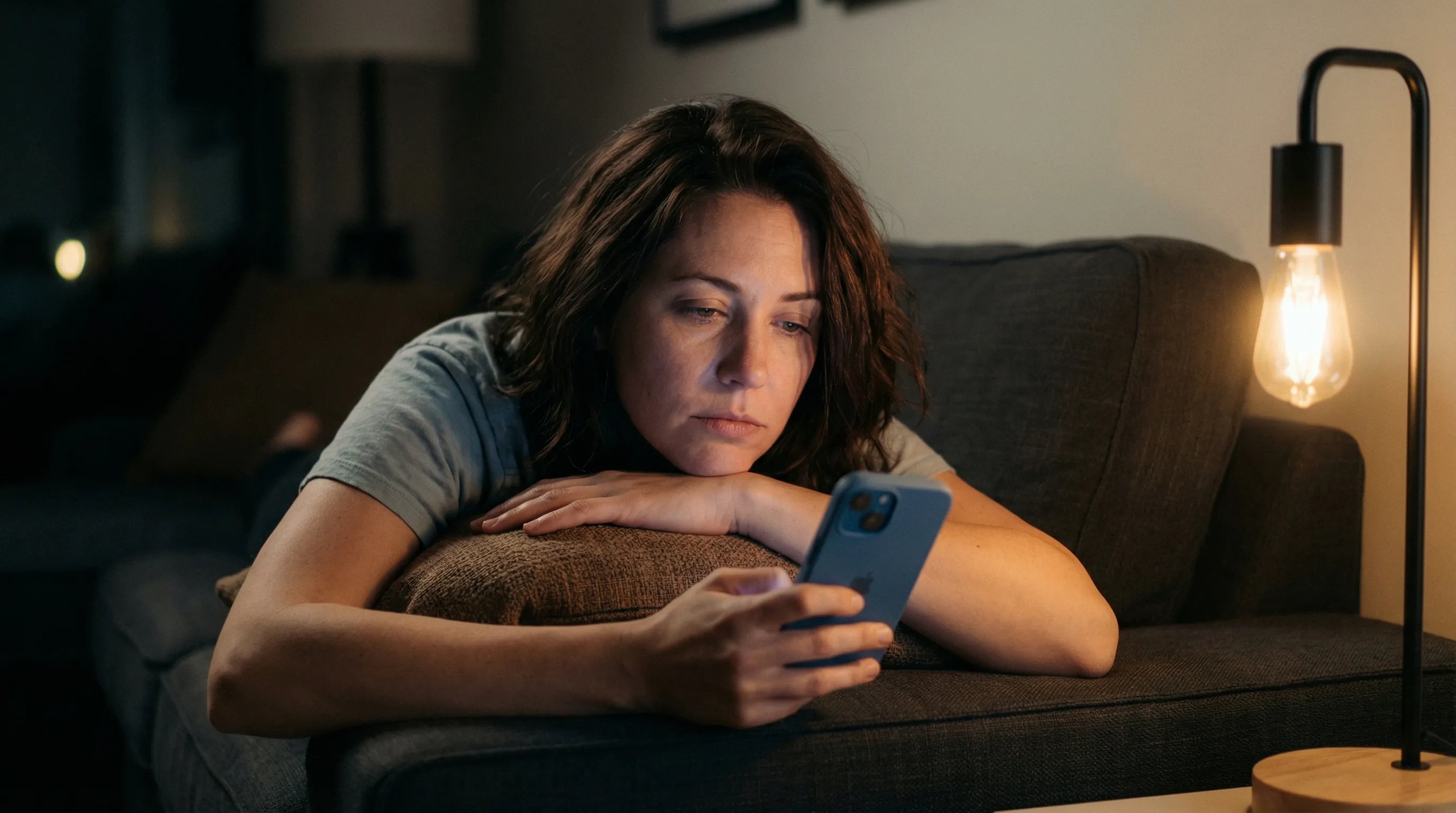
Here is a quick test.
You pick up your phone. You scroll for a while. You put it down. How do you feel?
If the answer is “worse than before” (more anxious, more drained, more hopeless) you are probably doomscrolling. If you cannot remember why you picked up the phone in the first place, you are definitely doomscrolling.
Doomscrolling is the compulsive habit of scrolling through negative, distressing, or emotionally charged content. It feels productive in the moment. It leaves you feeling empty afterward.
Here are seven signs that your scrolling has crossed the line.
Sign 1: The Phantom Pickup
You are sitting on the couch. Your phone is on the table. Suddenly it is in your hand.
You did not decide to pick it up. There was no notification. No specific task. The phone just appeared, and you are already scrolling.
This is the earliest sign. Scrolling has become a reflex, not a choice. Your brain learned to associate certain moments (boredom, stress, waiting, any empty moment) with the phone. The habit activates without your permission.
Sign 2: The Emotional Hangover
You put down your phone. You feel… worse. More anxious. More drained. More hopeless about the world.
Healthy screen use should leave you feeling neutral or better. Doomscrolling does the opposite. The content you consumed was negative, alarming, emotionally intense. It felt important in the moment. Now it just feels heavy.
If you consistently feel worse after scrolling than before, that is a clear signal.
Sign 3: The Time Warp
You pick up your phone to check one thing. You look up. Thirty minutes have vanished.
This is not occasional distraction. This is consistent time loss. Doomscrolling creates a state where minutes feel like seconds. The content is designed to eliminate natural stopping points. Infinite scroll. Autoplay. Algorithmic feeds that never end.
If you regularly lose chunks of time to scrolling, the habit has taken control.
Sign 4: The “Just One More” Loop
It is 11:30pm. You have to wake up at 6am. You know you should put the phone down. You scroll one more time. Then one more. Then one more.
This is the defining feature of compulsive behavior: continuing despite knowing better. Scrolling past bedtime. Scrolling during work with deadlines looming. Scrolling during family time while your kids try to get your attention.
The gap between “I should stop” and actually stopping is where doomscrolling lives.
Sign 5: The Separation Anxiety
Your phone is in another room. You feel restless. Uncomfortable. Like something is missing.
This is not about missing important information. It is about losing access to the coping mechanism that scrolling has become. The phone regulates your emotions now. Its absence creates discomfort.
If you feel anxious when your phone is not within reach, the relationship has become unhealthy.
Sign 6: The Darkening Worldview
The world seems worse than it used to. More dangerous. More divided. More hopeless.
But nothing in your actual life has changed. Your job is the same. Your relationships are the same. Your neighborhood is the same. So why does everything feel darker?
Doomscrolling distorts perception. Algorithms prioritize content that captures attention, and fear captures attention better than calm. Over time, consuming this content skews your view of reality. The problem is not the world. It is what you are consuming.
Sign 7: The Displacement
You used to read. You used to exercise. You used to have hobbies. Now you scroll.
Doomscrolling does not add to life. It replaces what was already there. The time has to come from somewhere. It comes from sleep, from movement, from conversations, from creating, from everything that used to fill your hours.
If activities you once enjoyed have faded while screen time has grown, scrolling has displaced the meaningful parts of your life.
How Many Signs Did You Recognize?
If you saw yourself in one or two, you are probably fine. Everyone scrolls sometimes.
If you saw yourself in three or more, the habit has crossed into problematic territory. The scrolling is affecting your mental health, your time, your relationships, your life.
Recognition is the first step. But recognition alone does not change behavior.
Why Willpower Does Not Work
Your brain evolved to seek information about potential threats. Checking for updates feels like regaining control. This instinct once helped humans survive.
Modern technology exploits this instinct. The phone offers endless information with zero effort. The reward system activates with each new piece of content. The feedback loop encourages more scrolling.
Doomscrolling also serves as a coping mechanism. It distracts from stress, boredom, difficult emotions. Trying to stop through willpower alone leaves a gap your brain will try to fill.
What Actually Works
Replacement, not restriction.
Instead of trying to eliminate scrolling, replace it with something that meets the same needs. Physical movement works particularly well. It provides stimulation, releases dopamine, improves mood, creates a sense of completion. Unlike scrolling, it leaves you feeling better.
This is the foundation of Scrolletics.
The app connects screen access to physical movement. Short exercises unlock screen time. Movement becomes the starting point, not an afterthought.
When scrolling requires earning access through movement, the automatic nature of the habit changes. Scrolling becomes intentional. The pattern shifts from mindless to conscious.
The Pattern Can Change
If you recognized yourself in these signs, you are not alone. Millions of people doomscroll. The platforms are designed to encourage exactly this behavior.
The problem is not a personal failing. It is a predictable response to systems built to capture attention.
But the pattern can change. Recognition is the first step. What you do next determines whether the pattern continues or breaks.
Movement before scrolling. That simple shift can change everything.
Frequently Asked Questions
What are the signs of doomscrolling?
The seven key signs are: picking up your phone without a reason (phantom pickup), feeling worse after scrolling (emotional hangover), losing large chunks of time (time warp), continuing despite wanting to stop (just one more loop), feeling restless without your phone (separation anxiety), developing a darker worldview, and replacing hobbies and activities with scrolling (displacement). If you recognize multiple signs, see our guide on doomscrolling as a modern addiction.
Is doomscrolling the same as phone addiction?
Doomscrolling is a specific pattern within broader phone addiction. It refers specifically to compulsive consumption of negative or anxiety-inducing content. Phone addiction can include other compulsive behaviors like checking notifications, social media comparison, or gaming. Doomscrolling is particularly harmful because it combines the addictive design of apps with emotionally distressing content. Learn more about why you are addicted to your phone.
How do I know if my scrolling has become a problem?
If you experience multiple signs simultaneously, especially the emotional hangover, time warp, and displacement signs, your scrolling has likely become problematic. The clearest indicator is whether scrolling is displacing activities that matter to you: sleep, exercise, hobbies, relationships, or work. See also: symptoms of too much screen time.
What is Scrolletics and how does it help stop doomscrolling?
Scrolletics interrupts the doomscrolling pattern by requiring physical exercise before you can access distracting apps. You do push-ups, squats, jumping jacks, or planks, and your phone counts reps automatically using on-device camera detection. One rep earns one minute of screen time. This makes scrolling intentional instead of automatic. No recording, no uploads, fully private.