

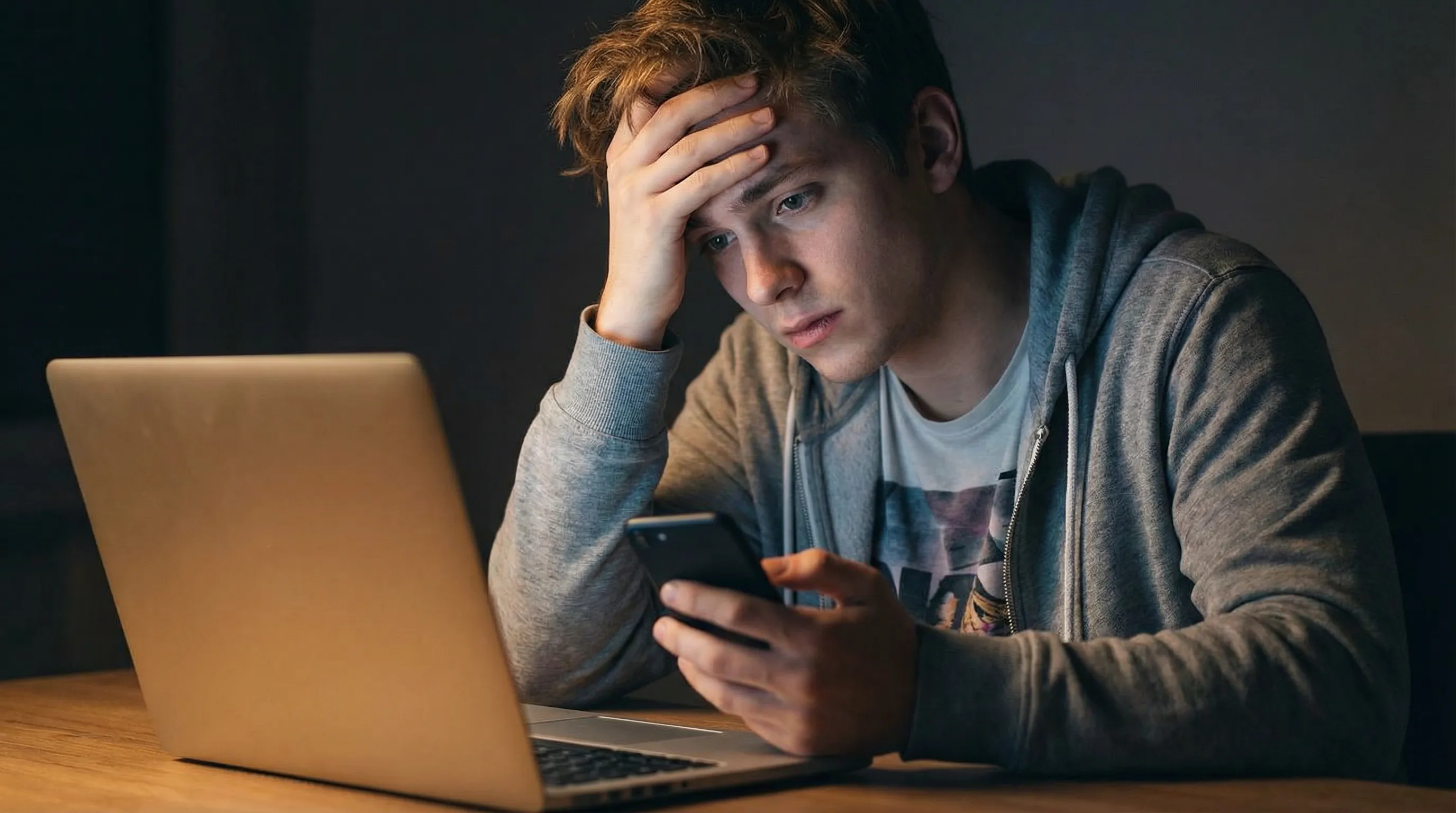
Many people notice their mental health has declined without understanding why.
Mood feels less stable. Anxiety shows up more often. Sleep becomes worse. Focus disappears. These changes can seem random or disconnected from daily habits.
For many, the common factor is screen time.
The connection is not always obvious. Screens do not announce their effects on mood or mental clarity. The changes happen gradually, which makes them easy to dismiss or attribute to other causes.
How Screen Time Creates Mental Health Problems
Screen time does not affect mental health simply because of how much time is spent looking at a device.
The issue is what happens during that time and how the brain responds to it.
Most screen use involves apps and platforms designed to capture and hold attention. As documented by the Center for Humane Technology, these systems rely on unpredictable rewards: content that might be interesting, engaging, or emotionally charged, but never guaranteed.
This unpredictability keeps the brain engaged in a state of constant anticipation. Over time, this expectation becomes automatic. The mind begins looking for stimulation from the screen even when it is not actively using the device.
When screen time becomes the primary source of stimulation, other activities feel less satisfying by comparison. This creates a cycle where the brain seeks out the easiest form of engagement, which reinforces the habit.
The Connection Between Screen Time and Anxiety
Anxiety related to screen use shows up in several ways.
One form is separation anxiety, which researchers call nomophobia. When the phone is not nearby or notifications are not checked regularly, restlessness and discomfort increase. This happens even when there is no logical reason to expect important information.
Another form is comparison anxiety. Research by psychologist Jean Twenge at San Diego State University has shown that social media exposes people to curated versions of others’ lives, which creates a sense of inadequacy or falling behind. Even when someone knows the content is selective, the emotional impact remains.
Information overload contributes as well. Constant exposure to news, opinions, and updates keeps the nervous system in a heightened state. The brain stays alert because it is processing too much input without enough time to rest.
Over time, this constant stimulation becomes the baseline. When the stimulation stops, the body interprets the absence as something wrong, which increases anxiety further.
The Link Between Screen Time and Depression
Depression connected to screen time often begins with withdrawal from activities that previously provided meaning or satisfaction.
When scrolling becomes the default response to boredom or discomfort, other behaviors get replaced. Hobbies, physical activity, social interaction, and time spent outdoors all decrease.
These activities are not just distractions. They support mental health by providing purpose, connection, and a sense of accomplishment. When they disappear, mood deteriorates.
Screen time also disrupts the reward system in the brain. The dopamine released during scrolling is immediate but shallow. It does not provide the deeper satisfaction that comes from completing a task, spending time with others, or moving the body.
Over time, the brain becomes less responsive to these meaningful rewards. Everything starts to feel flat or uninteresting unless it comes from a screen.
The scale of the problem becomes clearer when you see the numbers. The Screen Time Calculator translates your daily screen hours into days and years of your life. For most people, the result is the moment the habit stops feeling harmless.
How Screen Time Disrupts Sleep and Mental Health
Sleep problems caused by screen time do more than create fatigue.
Blue light from screens interferes with melatonin production, which makes it harder to fall asleep. Even when sleep happens, the quality is often poor because the brain remains in an activated state.
Poor sleep worsens mental health in multiple ways. It reduces emotional regulation, making it harder to manage stress or negative thoughts. It impairs focus and decision-making. It increases irritability and sensitivity to minor frustrations.
This creates a feedback loop. Screen time disrupts sleep, which worsens mood and mental clarity, which makes it harder to resist the urge to scroll, which further disrupts sleep.
Breaking this cycle requires changing more than just sleep habits. It requires addressing the screen habit that interferes with rest in the first place.
Why “Just Reduce Screen Time” Does Not Work for Mental Health
Most advice about screen time and mental health focuses on reduction.
Set limits. Take breaks. Spend less time online. These suggestions sound reasonable, but they rarely lead to lasting improvement.
The problem is that screen time is not just a habit. For many people, it functions as a coping mechanism. It provides temporary relief from boredom, stress, or negative emotions.
When someone tries to reduce screen time without replacing it with another action, the discomfort does not go away. The urge remains, and willpower alone is not enough to resist it consistently.
This is why most attempts to cut back fail. The underlying need for stimulation, distraction, or emotional regulation is still present. Without an alternative, the habit returns.
What Movement Does for Mental Health
Physical movement affects mental health in ways that screen time cannot replicate.
According to a meta-analysis published in the British Journal of Sports Medicine, exercise can be as effective as medication for treating symptoms of depression and anxiety. Exercise releases endorphins, which improve mood naturally. It reduces cortisol levels, which lowers stress and anxiety. It increases blood flow to the brain, which supports focus and cognitive function.
Movement also provides a sense of completion. Unlike scrolling, which can continue indefinitely, physical activity has a clear beginning and end. This creates a feeling of accomplishment that supports mental well-being.
Even short bursts of activity (push-ups, squats, jumping jacks) can reset attention and reduce the urge to reach for a phone. The body gets the stimulation it needs without relying on a screen.
When movement becomes a regular part of daily life, mental health improves in measurable ways. Mood stabilizes. Sleep quality increases. Anxiety decreases. Focus returns.
Making Movement the Starting Point
The challenge is not understanding that movement helps. The challenge is making it happen consistently.
Most people know they should exercise more and scroll less. Knowing this does not make it easier to do.
What works better is changing the structure so that movement happens before screen time, not as a separate task that competes for attention.
This is the foundation of Scrolletics.
Rather than asking people to resist the urge to scroll or forcing them to choose between movement and screen time, the app connects the two. Physical activity unlocks screen access. One rep earns one minute.
This shifts the relationship between movement and screens. Movement becomes the entry point instead of something that gets delayed or skipped. Screen time becomes more intentional because it follows an action that requires effort.
Over time, this changes how both habits function. Movement becomes automatic because it is required. Screen use becomes less automatic because it is no longer the default response to every moment of restlessness or boredom.
When Mental Health Depends on Changing the System
Mental health problems related to screen time are not a personal failing.
They are the result of a system designed to hold attention without regard for how that affects the person using it. Changing mental health outcomes requires changing the system, not just trying harder to resist it.
Movement provides the most reliable way to interrupt the habit loop without relying on willpower. It meets the brain’s need for stimulation and reward in a way that supports mental health rather than undermining it.
If screen time has started affecting mood, sleep, or mental clarity, the solution is not to eliminate screens. The solution is to make movement the starting point so that screen time becomes a choice instead of a reflex.
Frequently Asked Questions
Does screen time cause anxiety and depression?
Excessive screen time is strongly associated with increased anxiety and depression. The American Psychological Association links heavy screen use to chronic stress. The constant stimulation keeps the nervous system in a heightened state, while social media comparison worsens self-esteem. The dopamine patterns from scrolling also make other activities feel unrewarding, contributing to low mood. Learn more about screen time and anxiety.
How does screen time affect sleep and mental health?
Blue light from screens suppresses melatonin production, making it harder to fall asleep. Poor sleep then worsens mood, reduces emotional regulation, and increases anxiety. This creates a feedback loop where screen time disrupts sleep, which worsens mental health, which drives more screen use as a coping mechanism. See our guide on why limiting screen time before bed matters.
Why does reducing screen time alone not fix mental health?
Screen time often functions as a coping mechanism for stress, boredom, or negative emotions. Simply removing it leaves the underlying need unmet, so the urge persists and willpower eventually fails. Effective change requires replacing the habit with something that meets the same needs, like physical movement, which provides dopamine and stress relief through a healthier pathway. Read about what causes screen time addiction.
What is Scrolletics and how does it support mental health?
Scrolletics is an iOS app that connects screen access to physical movement. You complete exercises like push-ups, squats, or planks, and your phone counts reps automatically using on-device camera detection. One rep earns one minute of screen time. Exercise improves mood, reduces anxiety, and supports better sleep, which directly addresses the mental health effects of excessive screen use. No recording, no uploads, fully private.