

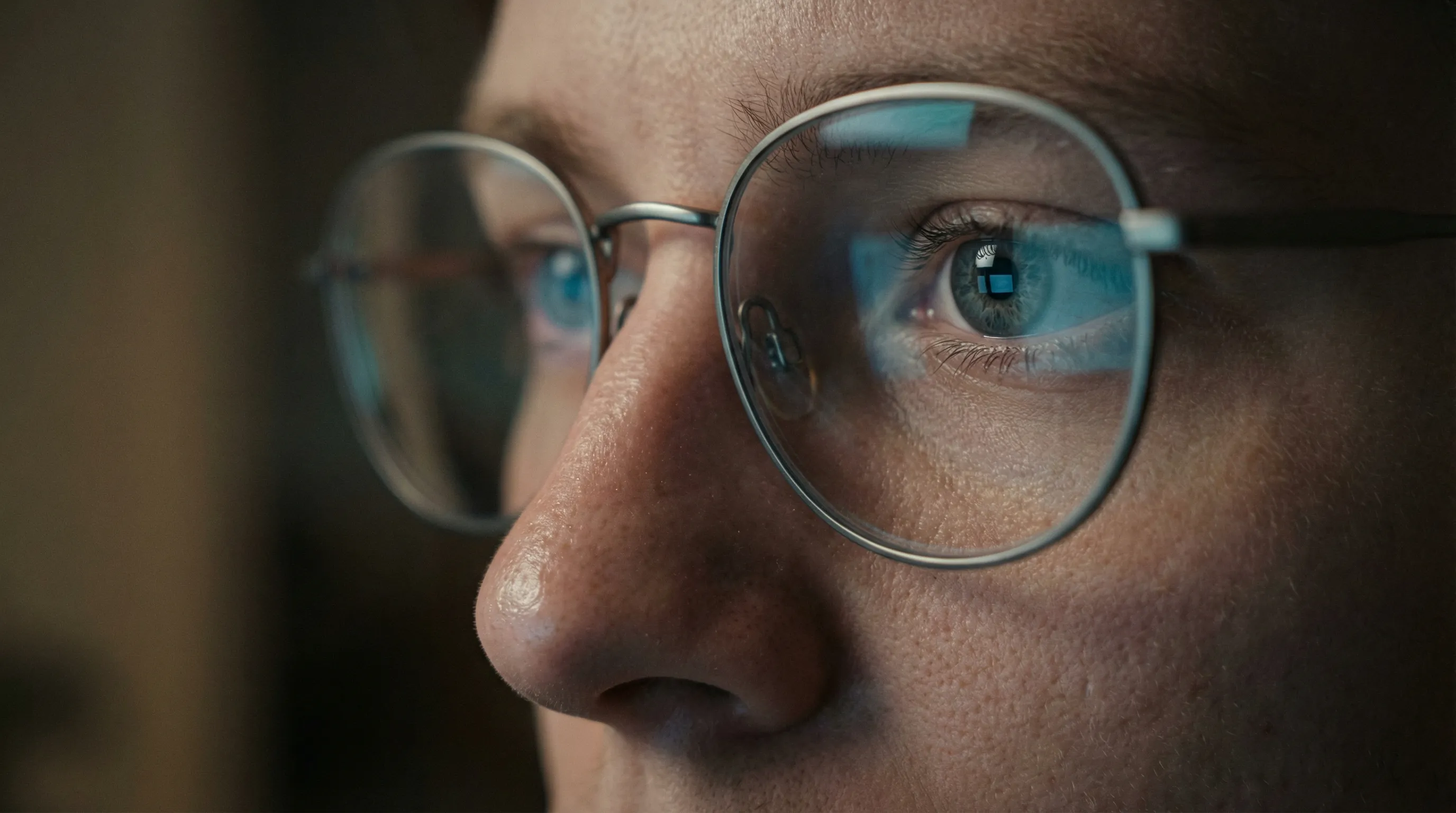
You know the feeling. It is 4pm, you have been staring at screens since morning, and your eyes are begging you to stop.
They burn. They feel dry. When you look away from the monitor, the world takes a second to come into focus. You rub them, blink hard, maybe squeeze them shut for a moment. Then you go right back to the screen.
This is not just tiredness. Your eyes are telling you something is wrong.
What Happens to Your Eyes During Screen Time
When you stare at a screen, your eyes work harder than almost any other activity demands.
Think about it. The tiny muscles that control your focus have to hold a precise position for hours. Unlike glancing around a room or looking at distant objects, screens lock your eyes at one fixed distance. Those muscles never get a break.
There is another problem you probably do not notice. You stop blinking. Normally, you blink 15 to 20 times per minute. On a screen, that drops to 5 or fewer. Each blink spreads moisture across your eye. Without it, your eyes dry out. That burning sensation? That is your eyes running out of lubrication.
Constant focusing plus reduced blinking equals digital eye strain. And almost everyone who uses screens regularly has it.
Digital Eye Strain: The Most Common Effect
Doctors call it computer vision syndrome. You probably just call it “my eyes hurt.”
The symptoms are familiar:
- Dry, gritty eyes that feel like sandpaper
- Vision that blurs after long sessions
- Headaches that settle behind your forehead
- Neck and shoulder pain from hunching toward the screen
- Trouble focusing when you finally look away
- Light that suddenly feels too bright
Here is the pattern. You feel fine in the morning. By afternoon, the discomfort builds. By evening, your eyes feel exhausted. You sleep, wake up, and the cycle starts again.
If you spend more than two hours at a time on screens, you are at risk. If you spend seven or more hours per day, you are almost certainly experiencing this already.
Why Blurred Vision Happens After Screen Use
You finish a long work session, look up, and the room seems slightly out of focus. You blink a few times. It clears, but something feels off.
This happens because your eye muscles are exhausted. They have been locked in one position for hours. When you finally ask them to focus on something at a different distance, they struggle to adjust. It is like trying to sprint after sitting in a car for eight hours.
For most people, the blur clears within minutes. But if this happens day after day, month after month, the recovery takes longer. The muscles never fully reset before the next session begins.
How Screens Contribute to Headaches
That afternoon headache that settles behind your eyes? It probably started with your screen.
Here is how it builds. Your eye muscles strain to maintain focus. That tension spreads to the muscles around your eyes, then to your forehead and temples. Meanwhile, you are hunching toward the screen, adding neck and shoulder strain to the mix.
Glare makes it worse. If your screen is brighter than your surroundings, or dimmer, your eyes work overtime to compensate. The mismatch creates additional strain that compounds throughout the day.
If headaches show up reliably after screen sessions, your eyes are sending a message. The question is whether you listen.
The Role of Blue Light in Eye Fatigue
You have probably heard about blue light. Maybe you bought glasses that claim to block it. But what is it actually doing to your eyes?
Blue light has a shorter wavelength and higher energy than other colors in the spectrum. Every screen you use emits it. Because of its properties, blue light scatters more easily, creating a kind of visual static that your eyes have to work harder to filter out.
The bigger problem is what blue light does to your sleep. It suppresses melatonin, the hormone that tells your body it is time to rest. Use screens in the evening, and you fall asleep later. Sleep poorly, and your eyes start the next day already tired.
This creates a cycle. Screen use disrupts sleep. Poor sleep means your eyes never fully recover. The next day, you start with a deficit. The strain accumulates faster. By the end of the week, your eyes feel permanently exhausted.
How Screen Time Affects Sleep and Eye Recovery
Sleep is when your eyes heal.
While you rest, your eyes finally get a break. Tear production stabilizes. The focusing muscles relax completely. Inflammation decreases. Your eyes reset for the next day.
But here is the problem. If you scroll through your phone before bed, blue light suppresses your melatonin. You fall asleep later. The sleep you get is lower quality. Your eyes do not fully recover.
The next morning, you wake up with eyes that are already tired. The strain from yesterday never fully cleared. Today’s screen time stacks on top of it. By Friday, you are running on empty.
That weekly strain extends across years. The Screen Time Calculator shows how many total days per year and years per lifetime your eyes spend locked on a screen. The number reframes eye strain from a daily annoyance to a long-term health question.
Why the 20-20-20 Rule Helps
You have probably heard this advice before. Every 20 minutes, look at something 20 feet away for 20 seconds.
It works. When you shift focus to a distant object, your eye muscles finally get to move. They have been locked in close-up mode. Looking far away lets them stretch and reset.
The problem is not the rule. The problem is remembering to follow it.
When you are deep in work or scrolling through content, 20 minutes disappears without a trace. You look up and an hour has passed. Your eyes are burning. You forgot to take a single break.
Advice you cannot follow is not actually helpful. The 20-20-20 rule needs a system behind it.
What Movement Does for Your Eyes
Here is something most eye health advice misses. Movement does more for your eyes than rest alone.
When you move, blood circulation increases everywhere, including to your eyes. Fresh oxygen and nutrients flow in. The recovery process accelerates.
But the bigger benefit is structural. Movement forces a real break. When you are doing push-ups or squats, you cannot also be staring at a screen. Your attention is occupied. Your eyes get genuine rest, not the fake rest where you look away for two seconds before checking your phone again.
Even short bursts work. Ten jumping jacks. A quick walk to the kitchen. A few stretches. Your eyes reset. Your focus muscles relax. You come back to the screen with fresh capacity instead of accumulated strain.
Making Breaks Automatic Instead of Optional
The real problem? Willpower does not work for screen breaks.
When you are absorbed in something, the idea of stopping feels like an interruption. You tell yourself you will take a break in a few minutes. Those minutes become an hour. Your eyes pay the price.
The solution is not to try harder. The solution is to build breaks into the structure of how you use screens.
This is the foundation of Scrolletics.
Instead of asking you to remember breaks, the app connects screen access to movement. Short exercises unlock screen time. One rep earns one minute. You cannot skip the break because the break is built into the system.
Your eyes get regular rest not because you remembered, but because the structure requires it. Movement happens before screen time, not as an afterthought you forget.
Over time, this changes everything. Sessions become shorter. Strain never accumulates to the point of pain. Your eyes feel different because the pattern of use is different.
Protecting Your Eyes Without Giving Up Screens
You are not going to stop using screens. Nobody is. That is not the goal.
The goal is to change how you use them so your eyes can recover between sessions.
Some of this is simple. Adjust your lighting so your screen is not the brightest thing in the room. Position your monitor at arm’s length. Remind yourself to blink. These small changes help.
But the biggest change is structural. Build movement into your screen routine. Make breaks automatic instead of optional. Give your eyes regular rest not through willpower, but through systems that require it.
If your eyes have been telling you something is wrong, listen. The burning, the blur, the headaches. These are signals. They are asking you to change the pattern before the damage becomes harder to reverse.
You do not have to give up screens. You just have to use them differently.
Frequently Asked Questions
How does screen time affect your eyes?
Prolonged screen use causes digital eye strain, also called computer vision syndrome. The American Optometric Association reports that screen use reduces blink rate from 15-20 times per minute to as few as 5, causing dry eyes, blurred vision, headaches, and neck pain. The eye muscles also fatigue from staying locked at a fixed focal distance for extended periods.
Does the 20-20-20 rule actually work for eye strain?
The 20-20-20 rule, recommended by the American Academy of Ophthalmology, does work: every 20 minutes, look at something 20 feet away for 20 seconds. The challenge is remembering to do it consistently. Building natural screen breaks through physical movement is more sustainable because it forces your eyes to refocus automatically.
Can blue light from screens damage your eyes permanently?
Current research from the American Academy of Ophthalmology suggests blue light from screens does not cause permanent eye damage. However, blue light does contribute to eye fatigue during use and suppresses melatonin production, disrupting sleep. Poor sleep then impairs the eye recovery that happens during rest. Learn more about why screen time before bed matters.
What is Scrolletics and how does it help with eye strain from screens?
Scrolletics creates automatic screen breaks by requiring physical exercise before you can use distracting apps. You do push-ups, squats, jumping jacks, or planks, and your phone counts reps using on-device camera detection. One rep earns one minute of screen time. Every exercise session gives your eyes a natural break, increases blood flow, and forces you to look away from the screen. No recording, no uploads, fully private.