

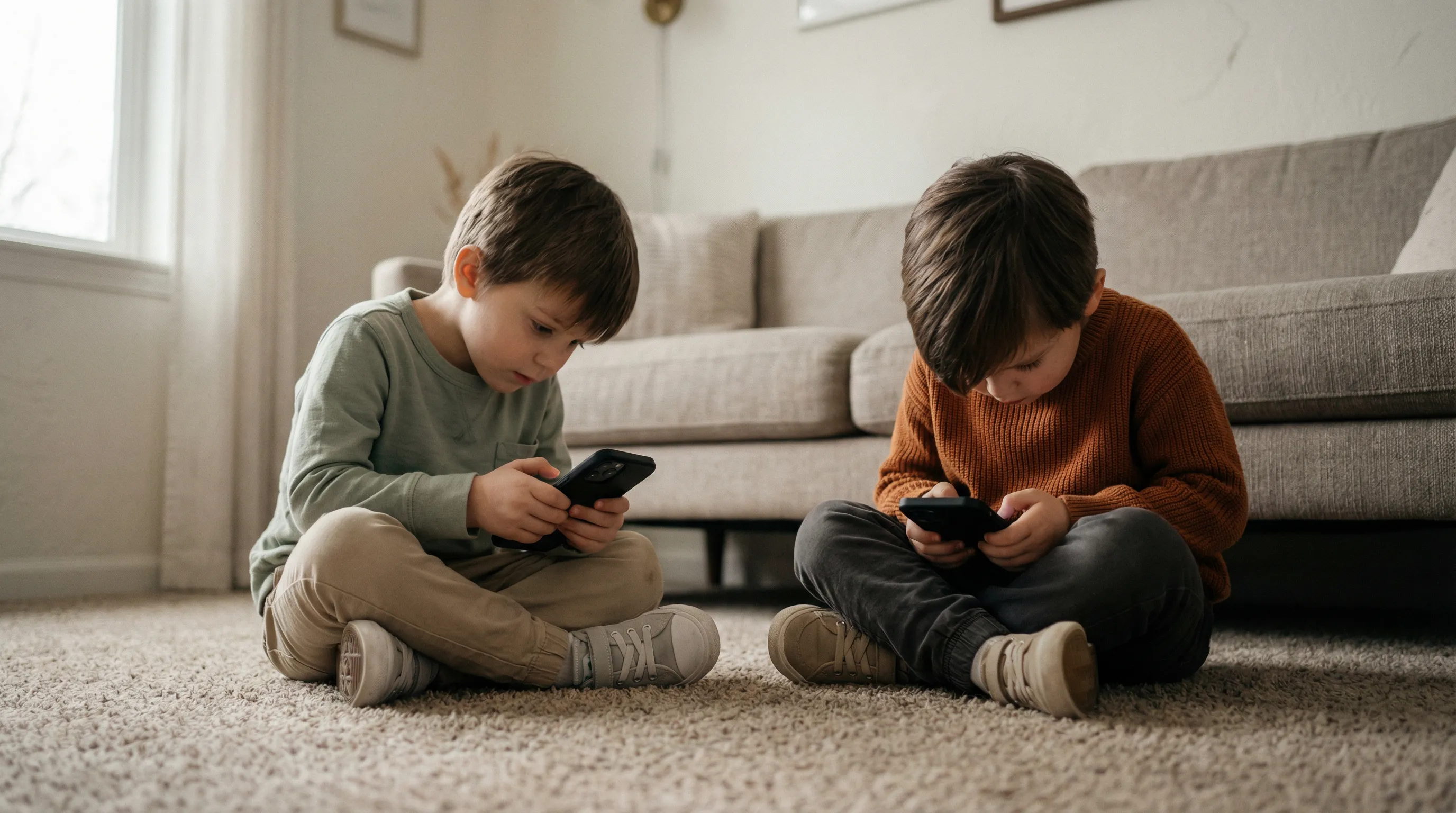
Your child’s brain is not a smaller version of an adult brain. It is a brain in the process of being built. The NIH ABCD Study, the largest long-term study of brain development in the United States, is tracking how screen time and other factors shape this process.
It is still forming. Still wiring itself. Still deciding which neural pathways to strengthen and which to prune away. This process is called neuroplasticity, and it is why children can learn languages so easily, pick up skills so quickly, adapt to new environments so readily.
It is also why excessive screen time matters so much.
The brain develops based on the stimulation it receives. When that stimulation comes primarily from screens (fast, bright, constantly changing, instantly rewarding) the brain adapts to that environment. The changes are measurable. And they are not always good.
What the Brain Scans Show
Researchers have put children in brain scanners. The differences are visible.
Brain scans of children with heavy screen use show visible differences compared to children with moderate use. Research published in JAMA Pediatrics found that the prefrontal cortex, the area responsible for decision-making, impulse control, and planning, may be less developed in children who spend significant time on screens. The part of the brain that helps your child think before acting, manage frustration, and make good choices is literally less developed.
The white matter tracts that connect different brain regions also appear affected. These pathways support complex thinking, language processing, and attention. Excessive screen time during development may impair how these connections form.
This is not speculation. It shows up on scans.
Why Everything Else Becomes Boring
Every notification, every new video, every level completed triggers a small release of dopamine in your child’s brain. Dopamine is the “reward” neurotransmitter. It makes things feel good. It makes the brain want more.
The problem is that screen-based dopamine comes too easily and too frequently. The brain adapts by becoming less sensitive. It needs more stimulation to feel the same reward.
This is why your child finds reading boring. Why playing outside feels pointless. Why homework is torture. Their reward system has been recalibrated around the intensity of screens. Everything else feels flat by comparison.
This is not laziness. It is neurological adaptation.
Why They Cannot Focus in School
Screen content is designed to capture attention through rapid changes, bright colors, constant novelty. Something new every few seconds.
This trains the brain to expect that pace. When the stimulation slows down (a classroom lesson, a book, a conversation) the brain struggles. It has learned to expect constant novelty. Anything slower feels unbearable.
This is why your child cannot sit still in class. Why they cannot read for more than a few minutes. Why they seem incapable of listening to you finish a sentence.
The attention difficulties persist even when screens are not present. The brain has been shaped by the screen environment. It functions that way everywhere.
The Meltdowns and Outbursts
Remember the prefrontal cortex, the part that is underdeveloped in heavy screen users? That is also the part that manages emotions.
Children with less prefrontal development have more difficulty managing frustration. They react more intensely to minor disappointments. They struggle to calm themselves when upset. They cannot delay gratification.
This is why your child melts down when you say no to more screen time. Why small frustrations trigger huge reactions. Why they seem to have no emotional regulation.
The meltdowns often get worse when you try to set limits. This makes parents reluctant to enforce boundaries. But the reactivity itself is a sign that the relationship with screens has become unhealthy.
The Sleep Problem
Blue light from screens suppresses melatonin. Stimulating content keeps the brain activated. The habit of screens before bed interferes with natural sleep cues.
Your child cannot fall asleep. Or they fall asleep but do not rest well. Either way, they wake up tired.
Sleep is when the brain consolidates learning, processes emotions, clears metabolic waste. When sleep is disrupted, all of this is impaired.
The effects cascade. Sleep-deprived children have worse attention, more emotional reactivity, greater difficulty learning. They are also more likely to seek screen stimulation to manage their fatigue. The cycle reinforces itself.
The Social Skills Gap
Children learn language, empathy, and social skills through face-to-face interaction. Reading facial expressions. Maintaining eye contact. Navigating the give-and-take of conversation. These skills develop through practice with real humans.
Screens cannot replicate this. Video calls lack the nonverbal cues. Social media lacks the real-time responsiveness. The learning does not transfer.
When screen time displaces in-person interaction, social skills develop more slowly. Your child may struggle to read emotions, maintain conversations, or connect with peers. These difficulties can persist into adolescence and adulthood.
Children who spend more time on screens and less time with people report higher rates of loneliness, anxiety, and depression. The isolation compounds.
The Body Connection
The brain does not exist in isolation. Physical health directly affects cognitive function.
Children who spend hours on devices are not running, climbing, playing. This sedentary behavior affects cardiovascular health, which affects blood flow to the brain.
Exercise also produces brain-derived neurotrophic factor (BDNF), a protein that supports the growth of new neurons and neural connections. When physical activity decreases, so does this support for brain development.
Your child’s brain needs movement to develop properly. Screens replace that movement.
What You Can Do
The effects are real. But they are not inevitable.
Set clear boundaries. Specific times when screens are allowed. Specific times when they are not. Consistency matters more than perfection.
Protect sleep. No screens in bedrooms. No screens in the hour before bed. The brain needs time to transition.
Prioritize movement. Physical activity counteracts many of these effects. Daily active play is not optional.
Model it yourself. If you are constantly on your phone, your child will expect the same. They learn from what they see.
Let them be bored. Boredom drives creativity. Having alternatives available (books, art supplies, outdoor equipment) makes the transition easier.
Making Movement the Gateway
The most effective strategy is connecting screen time to physical activity.
When children must move before they can access screens, everything changes. Physical activity increases. Screen time becomes intentional. The automatic reach for a device is interrupted by something that benefits the body and brain.
This works because it does not rely on constant enforcement. The structure creates the change.
Scrolletics is built on this principle.
The app connects movement to screen access. Physical exercises unlock screen time. One rep earns one minute. No battles. No negotiations. The system handles it.
For children, this transforms the relationship with screens. Movement becomes the starting point. Screen time becomes something earned. The brain gets what it needs to develop properly.
The Bottom Line
Your child’s brain is still forming. What they spend hours doing shapes how it develops.
Excessive screen time affects brain structure, dopamine sensitivity, attention, emotional regulation, sleep, social skills, and physical health. These effects are measurable. They are significant.
But they are not inevitable.
Movement, sleep, social connection, and real-world experience all support healthy brain development. When these are protected, screens can be part of a balanced childhood.
The developing brain will adapt to whatever environment it experiences. The question is what kind of adaptation you want to encourage.
Frequently Asked Questions
How does screen time affect a child’s brain development?
The NIH ABCD Study found that children with heavy screen use show measurable differences in brain structure, including less developed prefrontal cortex and affected white matter integrity. Excessive screen time also recalibrates the dopamine system, making non-screen activities feel boring, and impairs attention, emotional regulation, and social skill development during critical growth periods.
At what age is screen time most harmful to brain development?
The first five years are the most sensitive period. The WHO recommends no screen time for children under 2 and no more than one hour for ages 2-4. However, brain development continues through adolescence, with the prefrontal cortex not fully maturing until the mid-twenties. Heavy screen use during any developmental period can shape neural pathways in lasting ways. See also: healthy screen time for teenagers.
Can the effects of too much screen time on a child’s brain be reversed?
The brain remains plastic throughout childhood and adolescence. Reducing screen time and increasing physical activity, face-to-face social interaction, outdoor play, and sleep can support healthier brain development. The earlier the intervention, the more effective it tends to be. Movement is particularly important because it promotes BDNF production, which supports new neural connections.
What is Scrolletics and how does it protect children’s brain development?
Scrolletics requires physical exercise before children can access distracting apps. Kids do push-ups, squats, jumping jacks, or planks, and the phone counts reps automatically using on-device camera detection. One rep earns one minute of screen time. This ensures movement happens before every screen session, supporting the physical activity that developing brains need. No recording, no uploads, fully private.