

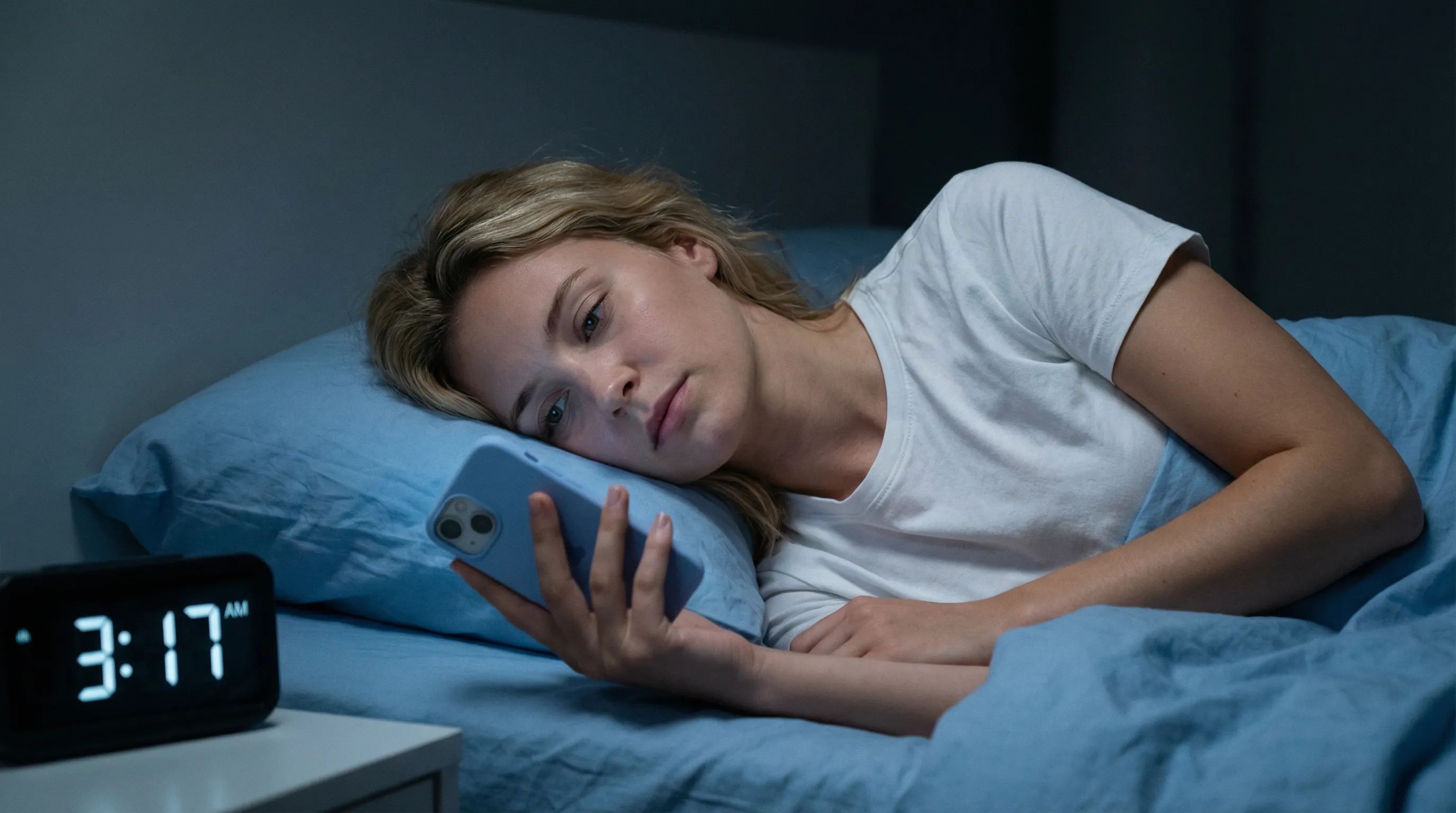
Scrolling in bed feels like winding down. It is actually winding you up.
Your body is tired. Your brain wants rest. But instead of drifting off, you are watching one more video, checking one more notification, scrolling one more feed. An hour passes. You are still awake, and now you are more wired than when you got into bed.
This is not a willpower problem. Your phone is actively fighting your sleep. The light it emits, the content it delivers, the habits it creates. All of it works against the rest your body needs.
The damage goes beyond one tired morning. Poor sleep affects your mood, your focus, your health, and your ability to handle stress. Night after night, it compounds.
How Blue Light Disrupts Your Sleep Cycle
Your phone is a miniature sun. At least, that is how your brain sees it. Research published in PNAS confirmed that light-emitting screens significantly suppress melatonin and delay sleep onset.
Blue light from screens is the same wavelength that tells your brain it is daytime. During the day, this is useful. At night, it is sabotage.
When blue light hits your eyes in the evening, it suppresses melatonin, the hormone that tells your body to prepare for sleep. Even 30 minutes of screen time can delay melatonin release significantly. Your body wants to sleep, but your brain thinks the sun is still up.
The results:
- You take longer to fall asleep, sometimes an hour or more
- You spend less time in deep, restorative sleep
- You wake up more during the night
- You feel groggy and irritable the next morning
Your brain cannot tell the difference between sunlight and screen light. It responds the same way to both: stay awake, stay alert. Exactly what you do not need at midnight.
Why Mental Stimulation Keeps You Awake
Blue light is only half the problem. The content is the other half.
Every scroll activates your dopamine system. A new post. An interesting video. A notification. Each one delivers a small reward that keeps your brain hunting for the next one. You are not relaxing. You are in a state of constant anticipation.
Sleep requires the opposite. Your brain needs to disengage, to drift into an unfocused calm. Screen content prevents that transition. Even after you put the phone down, your mind keeps processing what you saw. The video replays. The comment bothers you. The news lingers.
Emotionally charged content makes it worse. Stressful headlines. Arguments in comment sections. Social comparisons that leave you feeling inadequate. All of it triggers cortisol, the stress hormone. Cortisol and sleep do not mix.
The Habit Loop That Makes Bedtime Scrolling Automatic
You do not decide to scroll in bed. It just happens.
The habit loop is simple: you get into bed (trigger), you pick up your phone (behavior), you get stimulation or distraction (reward). This loop has run so many times that it no longer requires thought. Your hand reaches for the phone before your brain even registers what is happening.
This is why telling yourself to stop does not work. The behavior is not a choice anymore. It is a reflex. You cannot willpower your way out of a reflex.
Breaking this habit requires changing the structure, not just the intention.
How Poor Sleep Affects Everything Else
Sleep is not downtime. It is when your brain does its most important work: consolidating memories, processing emotions, clearing out metabolic waste. As neuroscientist Matthew Walker explains in Why We Sleep, cut that short, and everything suffers.
Your mood – Sleep deprivation makes you irritable, anxious, and emotionally reactive. Small problems feel huge. Your fuse gets shorter every night you miss.
Your focus – Attention span drops. Decisions get harder. Tasks that should be easy feel exhausting. You are running on a depleted battery.
Your body – Poor sleep is linked to weight gain, weakened immunity, and increased risk of chronic disease. Your body cannot recover from daily stress if it never gets proper rest.
Your mental health – Sleep problems and depression feed each other. Poor sleep worsens anxiety. Anxiety worsens sleep. The spiral tightens.
For kids and teenagers, the effects are even more severe. The CDC recommends 8-10 hours of sleep for teens and 9-12 hours for younger children. Developing brains need more sleep, and they are more sensitive to disruption. Academic performance, behavior, emotional regulation. All of it suffers.
Why Common Advice Often Fails
You have heard the advice. Set a curfew. Keep devices out of the bedroom. Use blue light filters.
Sounds simple. Rarely works.
The problem is timing. Evenings are when you are most tired, most stressed, most depleted. Willpower is at its lowest exactly when you need it most. Telling yourself not to pick up the phone requires effort you may not have left.
Blue light filters help with the light problem but do nothing about the content or the habit. You are still scrolling. Your brain is still hunting for dopamine. You are just doing it with an orange tint.
Keeping devices out of the bedroom works better, but only if you replace the behavior. Without something else to do, the discomfort of breaking the habit sends you back to retrieve the phone. The gap needs to be filled.
What Actually Helps You Sleep Better
You cannot just remove the phone. You have to replace it with something.
Your brain needs an activity during the transition to sleep. Something engaging enough to satisfy it, but not stimulating enough to keep you awake. The right replacement fills the gap the phone used to fill.
A physical book – Reading engages your mind without blue light or infinite scroll. A chapter has an end. You close the book. You sleep.
Gentle stretching – Light movement releases the tension you have been carrying all day. It signals your body that the day is done.
Breathing exercises – Slow, deep breaths activate your parasympathetic nervous system. This is the “rest and digest” mode your body needs for sleep.
Journaling – Write down tomorrow’s tasks or today’s thoughts. Get them out of your head and onto paper. Your mind stops spinning.
The key is repetition. The replacement has to become the new habit. That takes consistency, not willpower.
Making Movement Part of the Evening Routine
People who move during the day sleep better at night. A meta-analysis in the British Journal of Sports Medicine confirmed that regular exercise significantly improves sleep quality.
Exercise regulates your circadian rhythm, burns off stress hormones, and creates the physical tiredness that makes falling asleep easier. If you want better sleep, movement is one of the most reliable ways to get it.
Movement can also replace evening screen time. Instead of scrolling to decompress, a short walk or some light stretching gives your brain the stimulation it wants while preparing your body for rest.
This is the foundation of Scrolletics.
The app connects screen access to physical movement throughout the day. When you move before you scroll, the habit loop changes. By evening, you have already gotten your movement in. The compulsive need to scroll before bed weakens because you are not running a dopamine deficit.
Over time, screens become tools you use deliberately, not reflexes you cannot control.
When Better Sleep Changes Everything
Sleep is the foundation. When it improves, everything else follows.
Your mood stabilizes. Your focus sharpens. Stress becomes manageable instead of overwhelming. Your body recovers properly. Your mind clears. The benefits compound night after night.
Limiting screen time before bed is one of the highest-impact changes you can make. You already know this. The challenge is not understanding why it matters. The challenge is building a system that makes the change stick.
If screens have become part of your bedtime routine, fighting the habit with willpower will not work. Replacing it with something better will. Movement during the day. A consistent wind-down routine. Screens out of the bedroom. A book instead of a phone.
The structure creates the change. Better sleep follows. And better sleep changes everything.
Frequently Asked Questions
Why is screen time before bed bad for sleep?
Blue light from screens suppresses melatonin production, the hormone that signals your body to sleep. Research published in PNAS found that screen use before bed significantly delays sleep onset and reduces next-morning alertness. The mental stimulation from content also keeps the brain in an alert state, making it harder to wind down.
How long before bed should I stop using screens?
The National Sleep Foundation recommends stopping screen use at least 30 to 60 minutes before bed. This gives melatonin levels time to rise naturally and allows the brain to transition from alert mode to sleep mode. Replacing screen time with reading, stretching, or breathing exercises makes the transition easier.
Do blue light glasses or night mode actually help?
Blue light filters reduce some blue light exposure but do not eliminate the problem. The mental stimulation from content, notifications, and scrolling still keeps the brain alert. Research suggests that the behavioral habit of scrolling is as disruptive to sleep as the light itself. Removing the screen entirely is more effective than filtering the light. See also: how screen time affects your eyes.
What is Scrolletics and how does it improve sleep?
Scrolletics connects screen access to physical exercise. By requiring movement before you can use distracting apps, it naturally reduces late-night scrolling because the effort barrier makes impulsive bedtime use less likely. Movement during the day also improves sleep quality. Your phone counts reps using on-device camera detection. No recording, no uploads, fully private.