

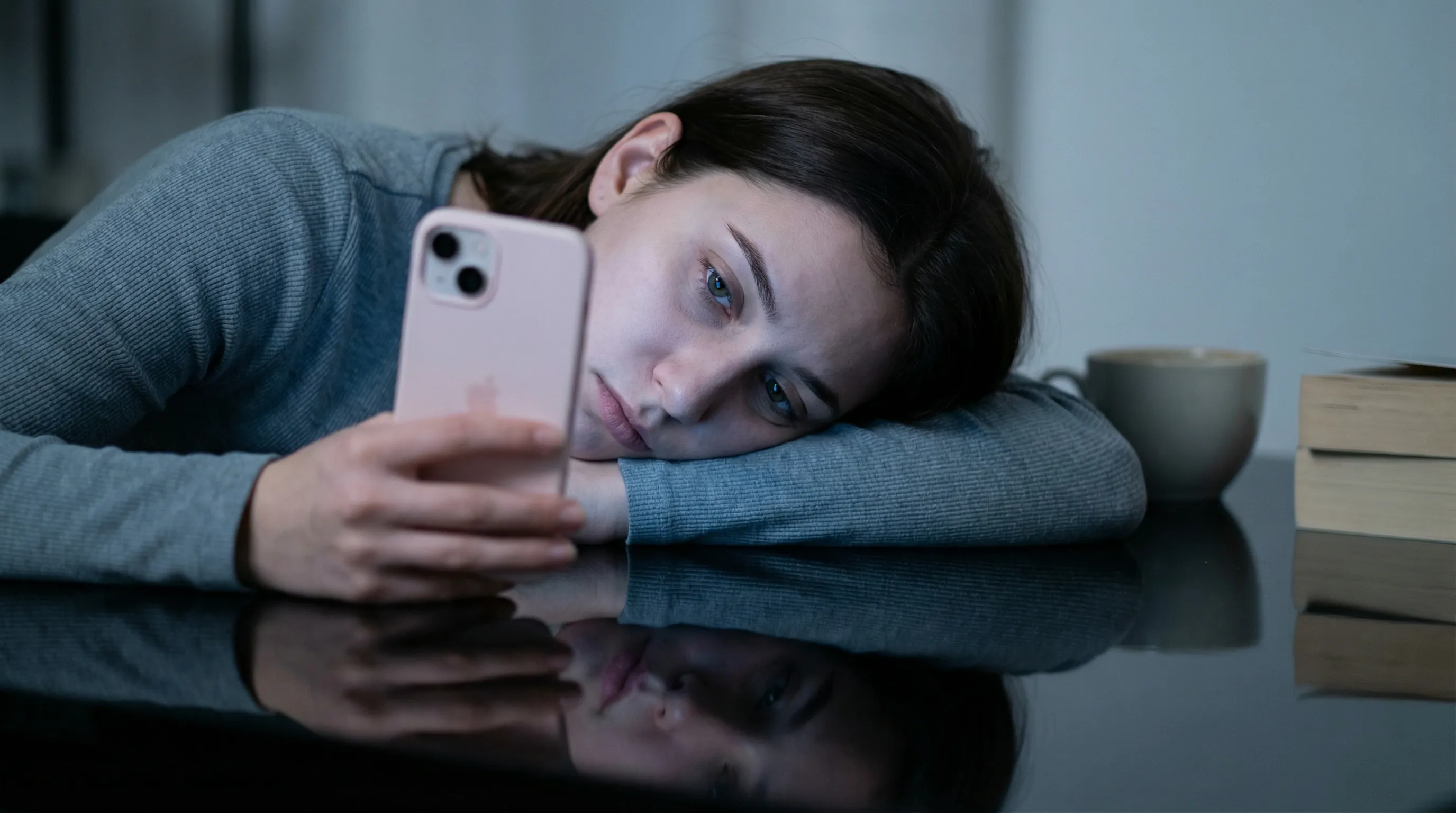
You put down your phone. Five minutes later, you pick it up again. You are not sure why.
There is a restlessness you cannot quite name. A low hum of tension that follows you through the day. You feel on edge even when nothing is wrong. Sleep comes harder than it used to. Focus slips away mid-sentence.
You have tried to relax, but relaxation does not stick. Something keeps pulling you back to the screen, and something about the screen keeps you from feeling calm.
This is not a coincidence. The connection between screen time and anxiety is real, and it runs deeper than most people realize.
How Screen Time Triggers Anxiety
It is not the hours that cause the problem. It is what happens during those hours.
Every time you use your phone, your brain is processing a stream of unpredictable stimulation. A notification arrives. You check it. The feed refreshes. You scroll. A message appears. You respond. Each interaction triggers a small spike of alertness as your brain asks: is this important?
This keeps your nervous system on high alert. Your brain stays ready to react, which prevents the natural relaxation that should happen during downtime. You never fully settle.
Over time, this constant alertness becomes your baseline. Your body forgets what calm feels like. Anxiety stops being a response to stress. It becomes the background noise of your life.
Why Blue Light Makes Anxiety Worse
Your phone is telling your brain to stay awake.
Blue light from screens suppresses melatonin, the hormone that signals rest. During the day, this is fine. Your brain should be alert. But when you scroll at night, or for hours at a time, you are artificially keeping your brain in activation mode.
The short-term effect: you cannot wind down. Your body is tired, but your brain is still buzzing. This disconnect feels like anxiety because it is. Your system is fighting itself.
The long-term effect: your brain gets used to overstimulation. Normal life starts to feel boring or flat. You need more input just to feel okay. The threshold for calm keeps rising, and you keep falling short of it.
How Task Switching Creates Background Anxiety
Think about what happens in a typical phone session. You check email. A notification pulls you to a message. You respond. You open social media. A video catches your attention. You watch half of it. You remember you were doing something else.
Each switch costs mental energy. Your brain has to reorient every time. It never fully settles into anything.
This fragmentation is exhausting. It creates a feeling of being behind, of never quite finishing, of always having something else demanding attention. That feeling? That is anxiety. And it grows with every hour of screen time.
The worst part is that it becomes so familiar you stop noticing it. It only becomes obvious when you step away from screens for a while and feel the tension finally release. That is when you realize how much you were carrying.
The Anxiety of Separation from Screens
Here is the strangest part. The anxiety does not stop when you put the phone down. Sometimes it gets worse.
You leave your phone in another room and feel a pull to go get it. You are at dinner without it and cannot stop thinking about what you might be missing. You know there is no urgent notification waiting, but the urge to check is still there.
This is called nomophobia, and it is more common than you might think. Your brain has learned to associate the phone with relief. When the phone is gone, the discomfort has nowhere to go. So you feel anxious about being without the thing that is making you anxious.
The device has become a security blanket. And like any dependency, separation triggers the stress response.
How many hours per day are feeding that cycle? The Screen Time Calculator shows what your daily screen time adds up to in days per year and years per lifetime. Seeing the number makes the anxiety-screen connection harder to dismiss as harmless.
Why Reducing Screen Time Alone Does Not Fix Anxiety
You have probably tried the obvious solutions. Set limits. Take breaks. Delete apps. Use blockers.
They work for a while. Then they stop working.
The problem is that your phone is not just a habit. It is a coping mechanism. You reach for it when you are bored, stressed, uncomfortable, or just need a break from your own thoughts. When you try to cut back without replacing it with something else, the discomfort does not disappear. It just sits there, waiting.
Willpower is not enough. Especially in the moments when you need relief most, when stress is high and self-control is low. That is exactly when the phone wins.
This is why most attempts to reduce screen time fail. The need is still there. Without an alternative, the habit always comes back.
What Actually Breaks the Anxiety Cycle
Movement does something screens cannot. It actually calms your nervous system.
When you move, your body releases endorphins that improve mood naturally. Cortisol levels drop. Your parasympathetic nervous system activates, which is the part that tells your body it is safe to relax.
Movement also gives you something scrolling never does: a sense of completion. A workout has a beginning and an end. You finish it. That feeling of accomplishment is real, and it supports mental well-being in ways that endless scrolling undermines.
Even short bursts work. Ten push-ups. A quick walk. A few jumping jacks. These small actions interrupt the anxiety cycle. They reset your attention and reduce the urge to reach for your phone.
When movement becomes regular, something shifts. Your nervous system learns to regulate itself again. The constant alertness starts to fade. Calm becomes possible.
Making Movement the Gateway to Screen Time
You already know movement helps. The problem is making it happen when the phone is right there and your brain wants relief now.
The solution is not to try harder. The solution is to change the structure so movement happens before screen time, not as a separate task you keep putting off.
This is the foundation of Scrolletics.
Instead of asking you to resist the urge to scroll, the app connects movement to screen access. Physical activity unlocks your phone. One rep earns one minute. You cannot skip the movement because it is built into the system.
This changes the relationship. Movement becomes the entry point, not something you delay. Screen time becomes intentional because it follows effort. The reflex weakens because the structure no longer supports it.
Over time, both habits shift. Movement becomes automatic because it is required. Scrolling becomes less automatic because it is no longer the default response to every uncomfortable moment.
When Anxiety Signals Something Deeper
This is not your fault.
The anxiety you feel is not a personal failing. It is the predictable result of systems designed to capture attention, combined with a nervous system that evolved long before screens existed. Your brain is responding exactly the way it was built to respond. The problem is the environment, not you.
Recognizing the connection is the first step. Changing the structure is what creates lasting results.
If screen time has started affecting how calm or focused you feel, the answer is not to eliminate screens entirely. The answer is to make movement the starting point, so that screen time becomes a choice instead of a reflex.
The restlessness can fade. The tension can release. But it will not happen by trying harder. It will happen by changing the system.
Frequently Asked Questions
Can too much screen time cause anxiety?
Yes. Excessive screen time keeps the nervous system in a constant state of alertness. Notifications, social media comparison, and information overload all contribute to heightened anxiety. Research from the American Psychological Association links heavy screen use to increased stress levels. Blue light also disrupts sleep, which further raises baseline anxiety. Learn more about how screen time affects mental health.
What is nomophobia?
Nomophobia is the anxiety or fear of being without your phone. It is characterized by restlessness, nervousness, and compulsive checking when the device is not nearby. Studies published in Computers in Human Behavior have identified it as a measurable condition affecting a significant portion of smartphone users.
Why does putting my phone down make me feel more anxious?
When screen time becomes a coping mechanism for stress or boredom, removing it leaves the underlying discomfort unaddressed. The brain has learned to rely on the phone for relief, so its absence triggers anxiety. This is why replacement strategies like physical movement work better than simple restriction. Movement provides the stimulation and relief the brain is seeking. See also: why willpower alone rarely works.
What is Scrolletics and how does it help with screen-related anxiety?
Scrolletics reduces screen-related anxiety by making movement the gateway to screen access. You complete exercises like push-ups, squats, or planks, and your phone counts reps automatically using on-device camera detection. One rep earns one minute of screen time. Exercise calms the nervous system, releases endorphins, and provides a sense of completion that scrolling cannot. No recording, no uploads, fully private.