

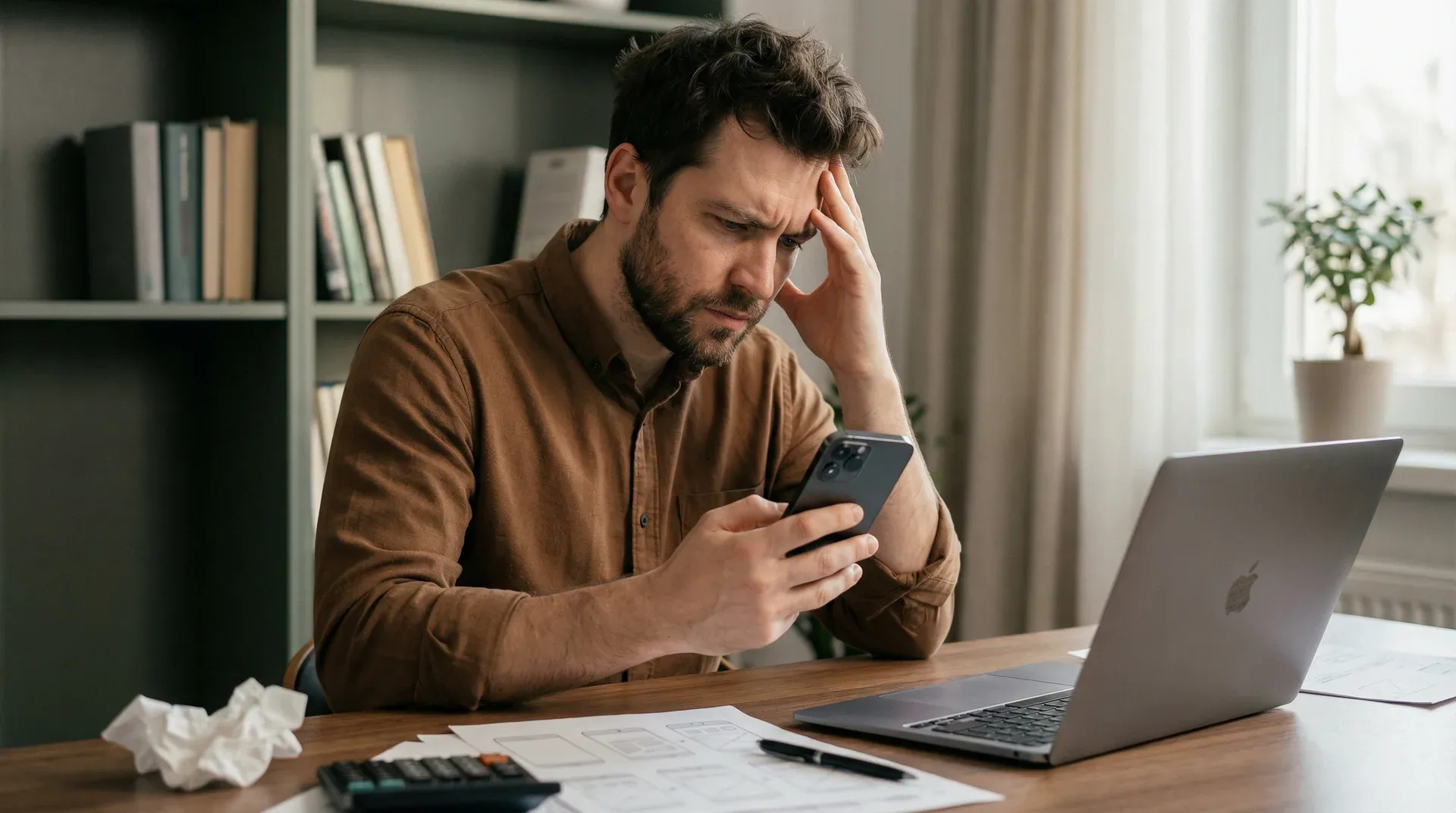
You have read the advice. Put your phone in another room. Set a timer. Use an app blocker. Just put it down.
You tried all of it. None of it worked. Not because you did not try hard enough. Because your brain does not work the way that advice assumes.
If you have ADHD, phone addiction is not the same problem as it is for everyone else. It is the same problem running on different hardware. And the standard solutions were not built for your hardware.
Here are 6 reasons phone addiction hits ADHD brains harder, and what actually helps when the usual advice fails.
Reason 1: Your Dopamine Baseline Is Lower
This is the core of the problem.
ADHD brains have lower baseline levels of dopamine. The neurotransmitter that drives motivation, focus, and reward is running at a deficit. Everything that requires sustained effort (studying, cleaning, working on a project) feels harder because the reward signal is weaker.
Your phone fixes this instantly. Every notification, every scroll, every refresh delivers a small dopamine hit. The phone provides the stimulation your brain is starving for, and it does it with zero effort.
This is not a character flaw. It is neurochemistry. The American Psychiatric Association confirms that dopamine dysregulation is a core feature of ADHD. Your brain is not choosing the phone over productive work. It is gravitating toward the only source of adequate stimulation available.
The phone is not your problem. It is your brain’s solution to a different problem. That is why willpower alone cannot beat it.
Reason 2: Executive Function Cannot Keep Up
Executive function is the brain’s ability to plan, prioritize, inhibit impulses, and switch between tasks. In ADHD, executive function is impaired.
This means the part of your brain responsible for saying “I should stop scrolling now” is the same part that is not working properly. You know you should stop. You can see the time passing. You understand the consequences. But the signal from your prefrontal cortex is too weak to override the dopamine pull from the phone.
Imagine trying to stop a car with brakes that only work at half strength. You can press the pedal. You can feel it engaging. But the car does not stop in time.
That is what executive dysfunction feels like with a phone in your hand.
Reason 3: Time Blindness Makes It Worse
ADHD affects time perception. Minutes feel like seconds when you are engaged in something stimulating. Hours disappear without any internal signal that time has passed.
Researchers call this time blindness. You sit down to check your phone for “just a minute.” Forty-five minutes later, you look up and genuinely cannot believe how much time has passed. You are not exaggerating. Your brain literally did not register the time.
This is why setting a mental intention to “only scroll for 5 minutes” fails. Your internal clock is unreliable. Five minutes and fifty minutes feel the same when the stimulation is high enough.
External timers help more than internal intentions. But even timers can be dismissed, snoozed, or ignored when the dopamine is flowing.
Reason 4: Hyperfocus Locks You In
ADHD is not just about distraction. It is also about hyperfocus, the ability to become completely absorbed in something to the exclusion of everything else.
Hyperfocus is often described as an ADHD superpower. It can be, when it locks onto something productive. But when it locks onto your phone, it becomes a trap.
During hyperfocus, the outside world disappears. Hunger signals go unnoticed. Bathroom needs are ignored. Responsibilities fade into the background. The phone becomes the entire universe.
Breaking out of hyperfocus requires an external interruption. An alarm. Another person. A physical change in environment. Internal motivation is not strong enough because the hyperfocused brain has temporarily disabled the systems that would generate it.
This is why “just put it down” is not helpful advice for ADHD. During hyperfocus, “just” is the hardest word in the English language.
Reason 5: Emotional Dysregulation Drives the Habit
ADHD includes emotional dysregulation. Emotions are felt more intensely and are harder to manage. Frustration, boredom, anxiety, and sadness hit harder and last longer.
The phone is the fastest emotional regulator available. Feeling anxious? Scroll. Feeling bored? Scroll. Feeling frustrated with a task? Scroll. The phone numbs the emotion instantly, which makes it the default coping mechanism.
Over time, the brain learns that the phone is the answer to every uncomfortable feeling. The emotional regulation skills that should develop through practice never get the chance because the phone short-circuits the process every time.
This creates a dependency that goes beyond habit. The phone becomes the primary tool for managing emotions. Taking it away without providing an alternative does not just create discomfort. It creates a vacuum. And the brain will fill that vacuum with the fastest available option, which is the phone again. For a deeper look at this cycle, see how screen time and anxiety reinforce each other.
Reason 6: Standard Advice Assumes a Neurotypical Brain
Most phone addiction advice is built on assumptions that do not apply to ADHD.
“Set a timer and stick to it.” Assumes reliable time perception. ADHD does not have that.
“Use willpower to resist the urge.” Assumes functional impulse control. ADHD has impaired impulse control.
“Track your screen time and set goals.” Assumes consistent self-monitoring. ADHD struggles with self-monitoring.
“Delete the apps.” Assumes the barrier of reinstalling will stop you. It takes 30 seconds to reinstall an app. That is not a barrier for an ADHD brain seeking dopamine.
The advice is not wrong. It is incomplete. It works for brains with functional executive systems. ADHD brains need a different approach.
What Actually Works for ADHD Phone Addiction
The strategies that work for ADHD share one feature: they do not rely on willpower, self-monitoring, or internal motivation. They use external structure.
Physical barriers. Put the phone in a locked box with a timer. Not in a drawer (you will open it). Not in another room (you will walk there). In something that physically prevents access for a set period. The barrier has to be stronger than the impulse.
Body doubling. Work alongside another person. The ADHD brain responds to external accountability in ways it does not respond to internal motivation. Study with a friend. Work in a coffee shop. Join a virtual coworking session. The other person does not need to monitor you. Their presence alone changes the equation.
Movement as replacement. When the urge to scroll hits, move your body instead. Push-ups. Squats. A walk. Jumping jacks. Movement provides dopamine through a pathway that does not create dependency. It meets the same need the phone meets, but without the negative spiral.
This is especially effective for ADHD because movement also improves executive function. Research published in the Journal of Attention Disorders confirms that physical activity improves attention, impulse control, and cognitive flexibility in people with ADHD. The movement does not just replace the phone. It strengthens the brain systems that make resisting the phone possible.
Environment design. Remove every trigger you can. Turn off all notifications. Use grayscale mode. Delete social media apps and only access them through a browser (the friction of typing a URL and logging in is enough to interrupt the automatic pattern). Charge the phone in another room at night.
Medication alignment. If you take ADHD medication, align your most challenging tasks with your medication window. The improved executive function is temporary. Use it to build habits and systems, not to white-knuckle through the day.
The ADHD-Specific System
For ADHD brains, the most effective approach combines physical movement with external structure.
Scrolletics was built for exactly this. The app connects screen access to physical exercise. Before you can use distracting apps, you complete a short workout. Push-ups, squats, or planks. Your phone counts reps automatically using on-device camera detection. One rep earns one minute.
For ADHD, this solves multiple problems at once. The physical barrier replaces willpower. The exercise provides dopamine through a healthier pathway. The movement improves executive function. And the system is external, so it works even when internal motivation is absent.
You do not have to remember to resist the phone. The system does it for you.
This Is Not an Excuse. It Is a Map.
Phone addiction with ADHD is not a moral failing. It is a predictable outcome of a brain that needs more stimulation, has less impulse control, and lives in a world full of devices designed to exploit both.
The 6 reasons above are not reasons to give up. They are coordinates. They show you exactly where the standard advice breaks down and where to build something that actually works.
Start with one external structure. One physical barrier. One movement-based replacement. Build from there.
Your brain works differently. Your strategy should too.
Frequently Asked Questions
Why is phone addiction worse with ADHD?
ADHD brains have lower baseline dopamine levels, making phones an irresistible source of stimulation. Combined with impaired executive function, time blindness, hyperfocus tendencies, and emotional dysregulation, ADHD creates unique vulnerability to phone addiction. The American Psychiatric Association confirms that dopamine dysregulation is a core feature of ADHD. For context on the broader pattern, see what phone addiction actually is and causes of phone addiction.
How can someone with ADHD break phone addiction?
Standard advice fails for ADHD because it relies on willpower and self-monitoring. Effective strategies include physical barriers (locked phone boxes), body doubling (working alongside others), movement-based alternatives, environment design (grayscale, deleted apps, notifications off), and medication alignment. The key is external structure. Learn more about how long it takes to break phone addiction.
Does ADHD medication help with phone addiction?
ADHD medication can improve executive function and impulse control, making it easier to resist the urge to check the phone. However, medication alone is usually not enough. The habit patterns require environmental and behavioral changes alongside medication. Research in the Journal of Attention Disorders confirms that combining medication with behavioral strategies produces the best outcomes.
What is Scrolletics and how does it help people with ADHD and phone addiction?
Scrolletics provides external structure by connecting screen access to physical exercise. You do push-ups, squats, or planks, and your phone counts reps automatically using on-device camera detection. One rep earns one minute. For ADHD brains, this replaces willpower with a physical system and provides dopamine through a healthier pathway. No recording, no uploads, fully private.